
Medical & Life Sciences: Defining the Boundaries of Diagnostic and Surgical Precision via Microlithography
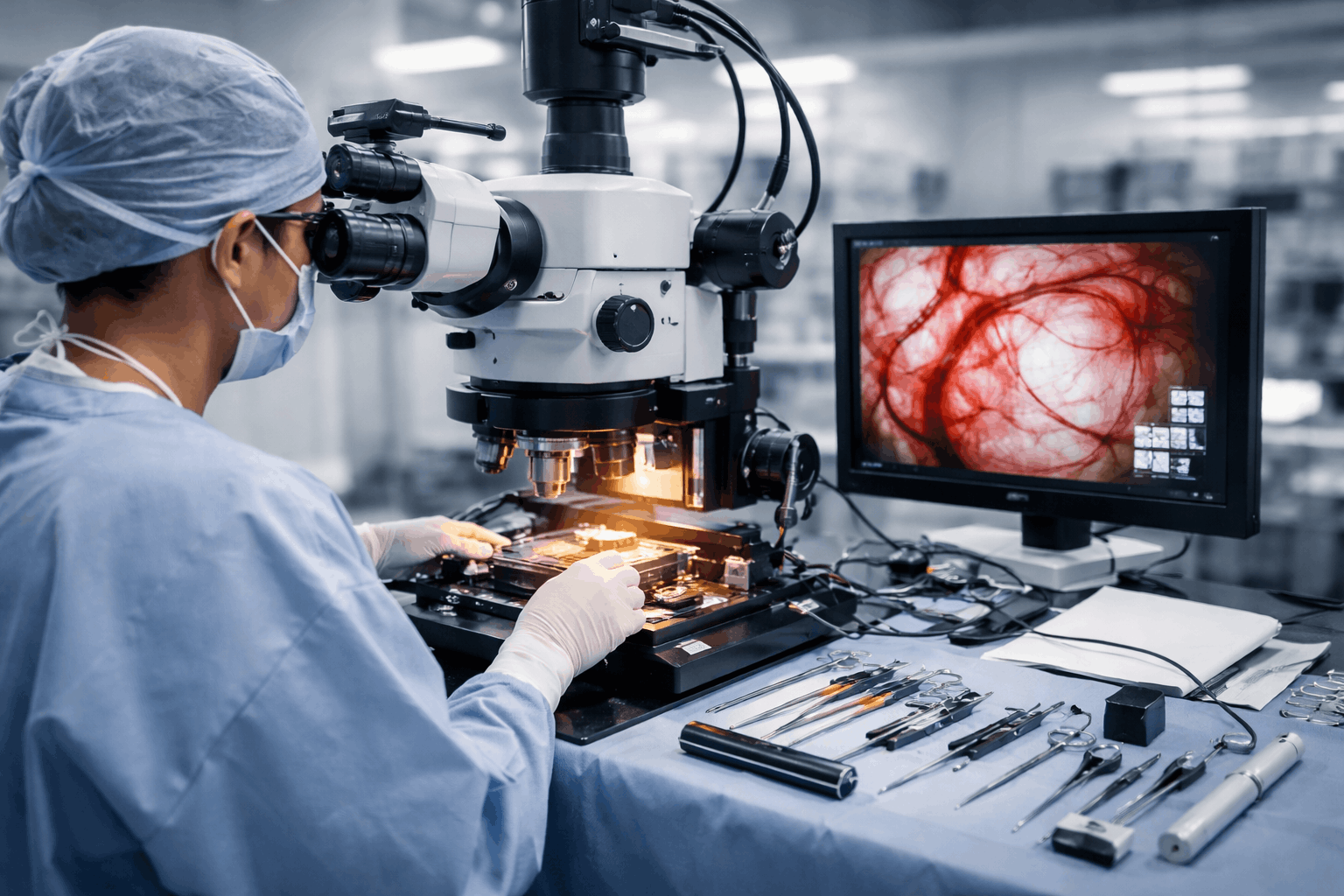
In the fields of medical and life sciences, every precise cellular analysis and every successful minimally invasive surgery relies on the support of micron-scale optical components. Photo Reticle brings the extreme craftsmanship of semiconductor photomask processing into the medical optics sector. By providing the core “Optical Foundation” for diagnostic instruments, surgical equipment, and microfluidic chips, we enable medical devices to surpass physical limits and safeguard human health.
The Technical Synergy: Photomask Technology and Medical Optics
The core of photomask fabrication is the creation of high-precision micro-patterns on substrates using photolithography. Many critical optical components in medical devices are essentially specialized photomasks. We leverage this technological cognacy to transform chip-manufacturing precision into performance advantages for medical optics.
Micron-scale Channel Fabrication for Microfluidic Chips: Microfluidic “Lab-on-a-Chip” devices require etched fluidic channels tens of microns wide to precisely control the flow paths of DNA samples and blood cells. Photo Reticle utilizes the same photolithography process used for semiconductor masks to fabricate high-precision channel patterns on quartz or specialized glass, ensuring width and depth tolerances are maintained within ±0.1μm. This precision directly dictates the accuracy of DNA sequencing; even a slight deviation can lead to uneven sample mixing, compromising test results.
Calibration Targets for Medical Imaging Systems: Ophthalmic laser surgery equipment and X-ray imaging detectors require high-precision targets for optical alignment. Our calibration targets utilize chrome-on-glass photomask technology to create micro-patterns on transparent quartz with a contrast ratio exceeding 99%. This ensures laser systems can accurately target retinal lesions and allows X-ray detectors to achieve sub-pixel image calibration—precision that is directly linked to surgical success rates and diagnostic reliability.
Beam-Shaping Elements for Surgical Lasers: Surgical laser tools require optical elements with specialized coatings to shape the laser beam, ensuring uniform energy distribution and avoiding damage to healthy tissue. Using lithographic techniques, we create nanometer-scale coating patterns on optical glass to precisely control wavelength and energy density, ensuring the laser acts accurately on the target tissue during procedures.
Core Technical Advantages: Meeting the Rigorous Standards of the Healthcare Industry
Medical optics demand standards far exceeding those of general industry, requiring high precision alongside biocompatibility and resistance to corrosive sterilization processes.
Biocompatible Substrate Materials: We utilize medical-grade quartz glass and specialized polymers that have passed ISO 10993 biocompatibility certification, ensuring no harmful substances are released upon contact with blood or bodily fluids. Additionally, substrate surfaces are specially treated to resist corrosion from disinfectants like alcohol and ethylene oxide (EtO), meeting the needs of repeated clinical sterilization.
High-Contrast Micro-patterning: Diagnostic instruments require extreme contrast to distinguish subtle sample differences. Our chrome photomask process achieves a 99.9% opacity rate, ensuring that in hematology analyzers, the optical signals of individual red blood cells can be clearly distinguished from plasma, preventing misdiagnosis.
Customized Micro-Aperture Design: We provide tailored micro-aperture components for various clinical scenarios. For instance, in flow cytometry, our 50μm micro-apertures precisely control cell flow speed for individual laser detection; in gene sequencers, our nanometer-scale apertures enable single-strand DNA capture, significantly enhancing sequencing efficiency.
Overcoming Special Challenges in Clinical Environments
Factors such as temperature fluctuations, chemical corrosion, and mechanical vibration can degrade optical performance. Photo Reticle’s designs are specifically hardened against these challenges.
Sterilization-Resistant Coatings: Optical elements in surgical lasers must withstand repeated high-temperature, high-pressure autoclaving. We utilize a specialized metallic chrome coating process that allows components to endure 134°C steam sterilization over 1,000 times without delamination, ensuring stable laser energy delivery.
Thermal Stability Engineering: Diagnostic instruments typically operate between 20-40°C. Through thermal expansion coefficient matching, we ensure that micro-pattern dimensional errors remain within ±0.05μm during temperature shifts, eliminating detection errors caused by thermal fluctuations.
Vibration-Resistant Structural Design: Portable medical devices face significant vibration during transport. Our components feature an integrated packaging design, where the micro-patterned substrate is laser-welded to a metal housing. This ensures that even under 10G of vibration, positional errors do not exceed ±0.1μm.
Industry Applications & Value
Our products are widely integrated across medical diagnostics, surgical treatment, and life science research, including:
In-Vitro Diagnostic (IVD) Equipment: Optical detection modules in hematology analyzers, gene sequencers, and immunoassay systems.
Surgical Treatment Systems: Beam-shaping elements in ophthalmic and dermatological laser therapy machines.
Life Science Research: Micro-scale channels in microfluidic and cell-culture chips for precise cell manipulation.
Medical Imaging Equipment: Calibration targets in X-ray detectors and Optical Coherence Tomography (OCT) systems for precise image calibration.
Summary
By applying semiconductor-level photomask processing, Photo Reticle provides the medical and life sciences industries with optical components of higher precision and stronger reliability. We understand that in the medical field, every micron of precision is a commitment to human health. We will continue to drive the fusion of photolithography and medical optics to provide the world with more accurate optical solutions.