
Defining the Next Generation of Robotic Spatial Awareness
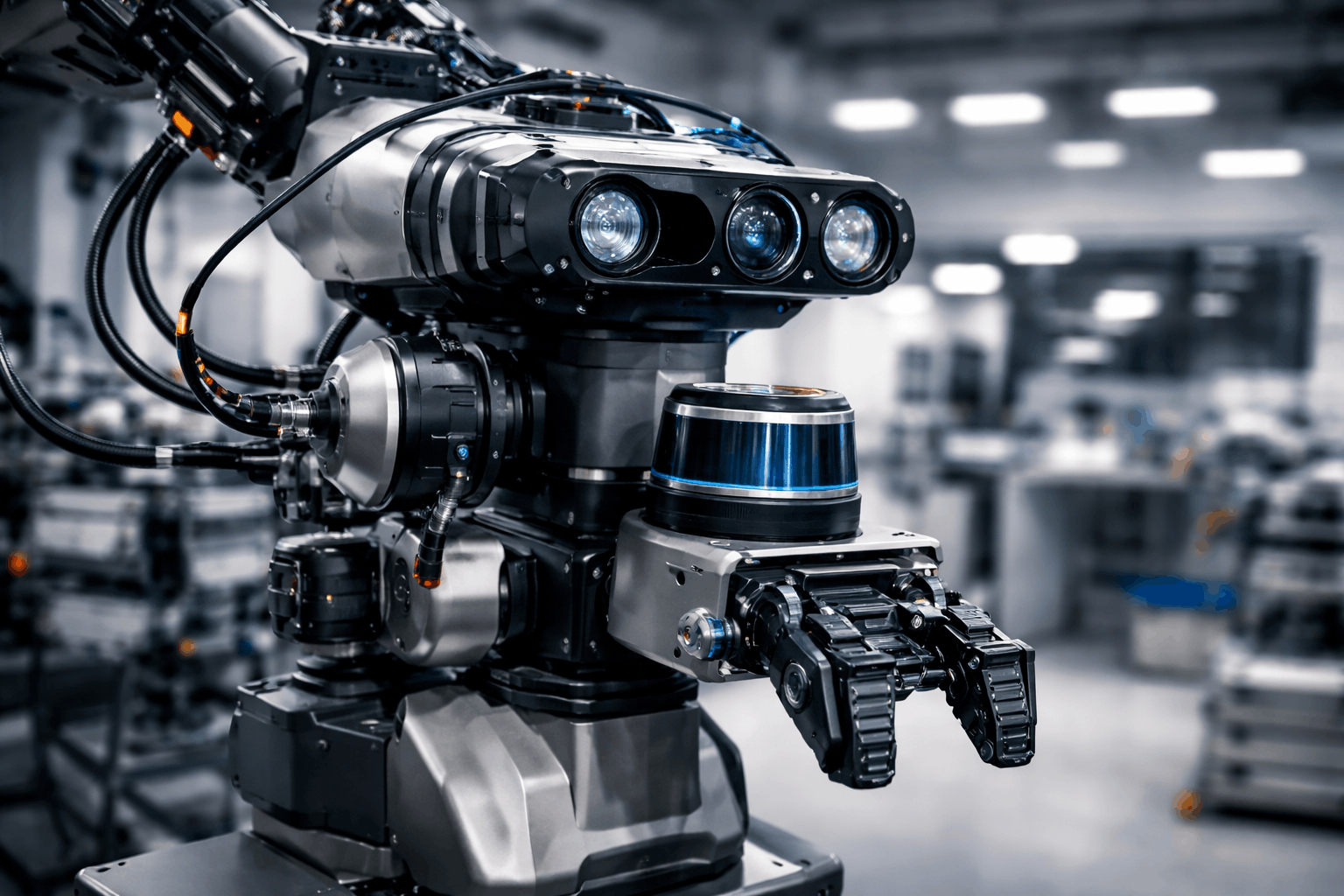
As robotics technology transitions from confined industrial cages to open, dynamic collaborative workspaces, the demand for precise spatial awareness has seen explosive growth. In this new era dominated by Autonomous Mobile Robots (AMR) and Human-Robot Collaboration, the high-precision rotary encoder patterns and LiDAR (Light Detection and Ranging) sensing elements manufactured by Photo Reticle are providing the foundational optical support for robotic “Spatial Intelligence.”
Our core optical components enable AMRs to navigate and map dynamic warehouse floors with centimeter or even millimeter-level precision. For Collaborative Robots (Cobots), our ultra-high-resolution encoder discs provide the high-definition positional feedback required for sophisticated human-machine interaction and complex assembly tasks. By minimizing mechanical tolerances and maximizing optical signal clarity, we empower robot manufacturers to build smarter, safer, and more dexterous automated partners.
The Technical Synergy: Photomask Processes and Robotic Perception
For a robot to “think like a human,” it must first “perceive like a human.” Photomask fabrication technology is intrinsically linked to the manufacturing of core robotic sensors, such as LiDAR and optical encoders. Photo Reticle leverages semiconductor-grade photolithography to solve physical limit challenges within robotic perception systems.
1. Fabricating the “Retina” of LiDAR Systems
LiDAR serves as the eyes of a robot, and the internal scanning mirrors and calibration patterns directly dictate detection precision.
Technological Cognacy: Manufacturing the MEMS (Micro-Electro-Mechanical Systems) scanning mirrors inside LiDAR requires the same precise photolithography and etching processes used in photomask production.
Precision Translation: The micron-scale calibration patterns we fabricate on glass substrates help LiDAR systems eliminate optical distortion during factory calibration. This ensures that when a robot performs SLAM (Simultaneous Localization and Mapping), the position of every wall and obstacle is captured with absolute accuracy.
2. The “Absolute Zero” of Optical Encoders
Cobots must maintain micron-level repeatability during high-speed movement, which relies entirely on the feedback from rotary encoders.
Photolithography Advantage: Unlike traditional mechanical discs, we use lithography to create extremely high-density grating patterns on metal or glass. This allows a disc of the same physical size to output significantly more pulse signals, enabling the robot’s joints to “feel” much smaller angular increments.
Eliminating Cumulative Error: Through high-precision Absolute Encoding patterns, a robot knows its exact position immediately upon power-up without the need for tedious “homing” sequences. This is critical for logistics robots required to operate 24/7.
Core Technical Advantages: Empowering Robots with “Spatial Intelligence”
In robotics, optical components must be both “precise” and “stable.” Our product designs are specifically optimized for the complex physical environments robots encounter.
Miniaturization & High-Density Patterning: As robotic joints become more compact, the space allocated for sensors is extremely restricted.
Integrated Micro-Actuators: We can fabricate thousands of lines on micro-diameter discs, meeting the stringent space requirements of miniature servo motors and dexterous robotic hands.
Enhanced Response Speed: High-density patterns allow for higher data sampling rates, enabling control systems to adjust posture at higher frequencies for smoother, safer movements.
Professional LiDAR Calibration & Reflection: LiDAR performance depends on the accuracy of its optical path.
Scanning Calibration Artifacts: We provide specialized patterns for internal optical path alignment, ensuring the emission and reception angles of the laser beam strictly match design intent.
High-Reflectivity Mirrors: Utilizing precision thin-film coating, our mirrors maximize laser return signals, improving detection capabilities for low-reflectivity objects (such as black cargo) or in high-ambient light environments.
Durability in High-Vibration Environments: Robotic operations involve high-frequency vibrations, challenging the adhesion and structural integrity of optical components.
Vibration-Resistant Design: Our lithographic patterns are etched directly into rugged substrates rather than simply printed on the surface, ensuring no pattern delamination or signal loss during long-term vibration.
Environmental Resilience: Products undergo specialized packaging and treatment to resist factory-floor oil and dust, guaranteeing long-term reliability in harsh operating conditions.
Industry Applications & Value
Photo Reticle’s optical solutions are empowering a diverse range of robotic systems:
Autonomous Mobile Robots (AMR/AGV): Warehousing, logistics, and delivery robots utilizing high-precision LiDAR patterns for navigation and obstacle avoidance.
Collaborative Robots (Cobots): Human-machine assembly arms using high-resolution encoders for force-control feedback and fine manipulation.
Quadruped & Humanoid Robots: Robots traversing complex terrains rely on our sensor components to maintain dynamic balance and gait control.
Machine Vision Systems: Industrial inspection cameras using our calibration targets for lens distortion correction to ensure the accuracy of visual metrology.