
Soda-Lime Glass Substrates
A clear start for optical patterns.
Product selection
What it is and what it does
Soda-lime glass is a sodium-calcium silicate glass used as a substrate for many photomask blanks and visible-light optical patterns. These substrates are supplied uncoated; chromium and photoresist coatings are specified separately. Material grade, dimensions, thickness, flatness and surface quality define the required blank.
When to choose it
Consider it for visible-light reference patterns and compatible mask processes with moderate temperature changes and no specialised UV material requirement.
How it differs from related products
Soda-lime glass is a practical general optical substrate. Borosilicate and fused silica offer different thermal behaviour; changing material does not replace a flatness or surface-quality requirement.
What can be customised
Material grade, outline, thickness, polished area and edge finish define the substrate. Coated versions also allow a film stack and resist preparation matched to the downstream exposure and etching process.
What you receive
The supplied item is an unpatterned substrate or coated blank in the selected process state. A finished reticle, encoder track or exposure mask requires a subsequent patterning step. Handling, storage and any accompanying inspection data depend on the selected coating and order.
Specifications and inspection
Product configuration
- Soda-lime glass grade and material identification
- Dimensions, thickness and edge finish
- Flatness, thickness variation and surface quality
- Operating wavelength, transmission and subsequent coating process
Choose the substrate for your wavelength and temperature range
Soda-lime glass is a practical starting material for many visible-light masks and patterned components. Low-expansion glass reduces thermal dimensional change. Fused silica is a strong choice when ultraviolet transmission and low thermal expansion are central requirements. Specify the exact glass grade; borosilicate glass and fused silica are not interchangeable names.
| Substrate material | Typical linear CTE (×10⁻⁶ K⁻¹) |
|---|---|
| Fused silica (quartz glass) | 0.4–0.5 |
| Low-expansion glass | 3.7 |
| Soda-lime glass | 9.4 |
These typical CTE values support material selection. The grade and temperature interval used for a dimensional calculation must be defined on the material specification. A generic low-expansion value does not identify a particular borosilicate grade.
For UV use, specify transmittance at the actual exposure wavelength and substrate thickness. The UV cut-on of soda-lime, white crown and borosilicate glass differs by grade. A thicker substrate can transmit less near its absorption edge; curves measured at different thicknesses are not directly interchangeable.
Inspection requirements
Verify material identification, dimensions, thickness, surface defects and flatness against the drawing. Define the inspection area and measurement method; specifications for a finished coated blank do not automatically apply to an uncoated substrate.
Double-side-polished soda-lime glass substrates for chrome coating, photomask blanks and patterned optical components.
Built for your process.
Request a Quote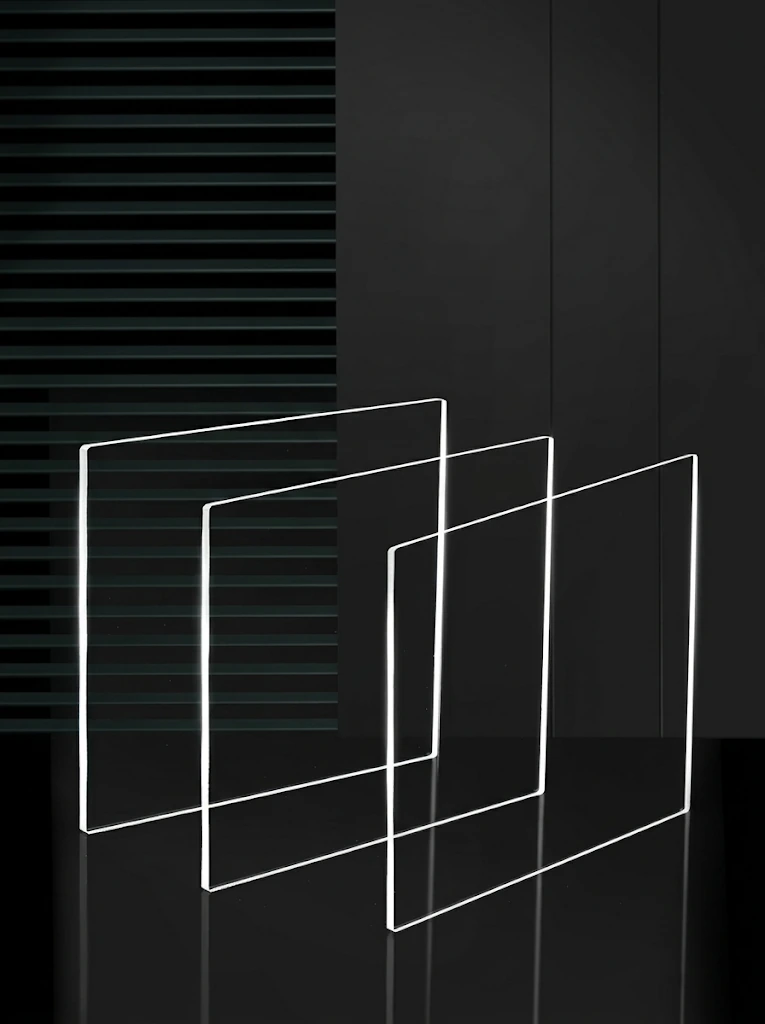
Substrate & optical configuration
Specify the glass or fused silica grade, dimensions, thickness, flatness, surface quality and edge condition before coating or patterning.
Quality & Inspection PhotolithographyCommon questions
Is soda-lime glass the same as borosilicate glass?
No. Soda-lime glass is sodium-calcium silicate glass; borosilicate glass is a different glass family containing boron oxide. Their thermal expansion and optical properties differ by grade. Specify the material explicitly rather than substituting one name for the other.
Selection notes
Soda-lime glass substrates provide a customisable transparent base for coatings, photolithography and patterned optical components.
Match the material to downstream processing and operating conditions before specifying thickness, flatness, useful area and edges.
Information for your inquiry
Glass grade, outline, thickness, surface, clear aperture, chamfers and subsequent coatings.
Can I order uncoated glass?
Yes. Define the bare-substrate material and surface requirements; coating and pattern processing are separate supply options.