
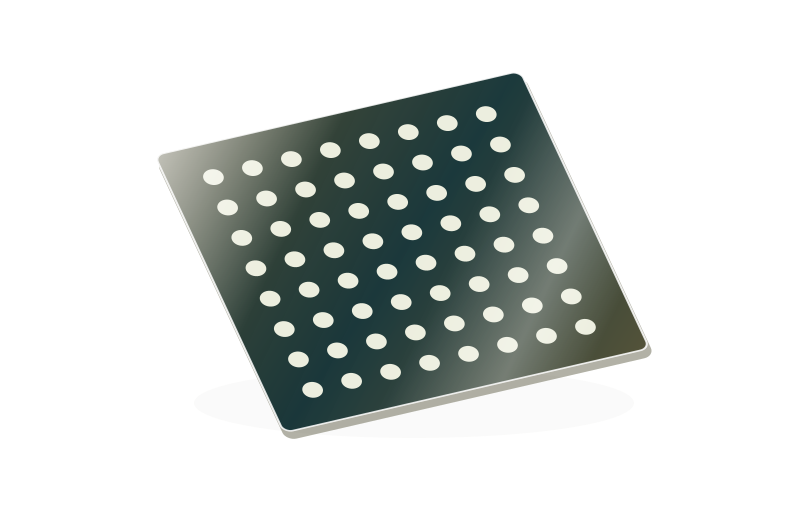
Aperture Patterned Glass

Define where light passes through the component.

Transparent openings in an opaque chromium film define optical apertures without a hole through the glass. Specify aperture dimensions, spacing and transmission requirements.

Aperture Patterned Glass

Product selection

What it is and what it does

Aperture-patterned glass uses transparent openings in an opaque film to define a transmitted field. The glass supports the openings without being pierced. Slits, circular apertures and arrays suit different beam, field and imaging tasks.

When to choose it

Choose a film-patterned aperture when the optical path can include a glass support and the instrument needs precisely located transparent windows within an opaque field.

Product selection and delivery

How it differs from related products

These are transparent openings in a film on intact glass. A drilled aperture removes the glass as well. Slits select an elongated region, circular windows select a bounded area and small-hole arrays provide repeated bright features.

What can be customised

Opening size and shape, centre coordinates, spacing, field coverage and surrounding opaque area can be combined with mounting references.

What you receive

A patterned glass component with the agreed coating geometry, substrate outline and inspection records.

Specifications and inspection

Product configuration

Aperture Patterned Glass
Opening geometrySlit, circular aperture or aperture array
Clear and opaque regionsCoating openings with an intact glass support
Placement referenceOpening coordinates relative to mounting datums

Inspection requirements

Inspect opening size, edge condition and position relative to the mounting datum. Define permitted leakage or defects in the opaque field at the operating wavelength.

An optical opening supported by glass

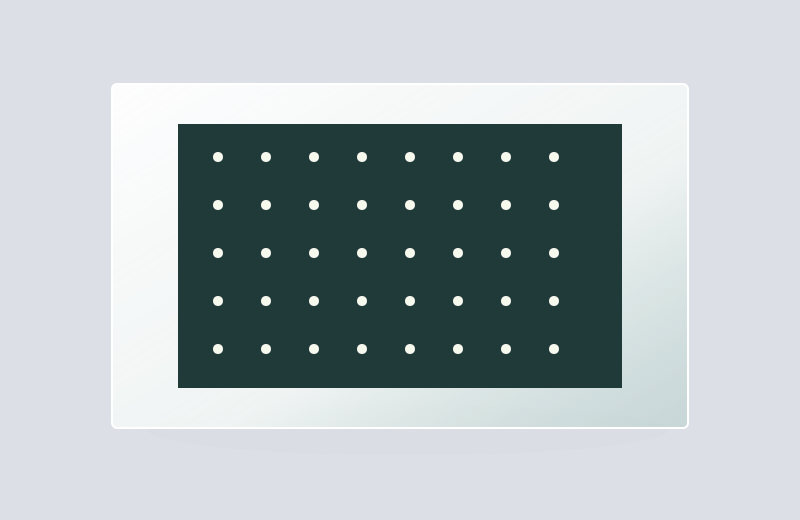
The coating boundary defines the opening. It can restrict a viewing region or create a transmitted line or point pattern, depending on its location in the optical system. Aperture diameter and substrate diameter are separate dimensions.

Consider the substrate in the optical path

Glass introduces wavelength-dependent transmission and surface reflections. In a converging beam, a plate can also change focus and aberration. Confirm thickness, orientation and any antireflection requirement with the optical design rather than treating a coated window as empty space.

When a physical hole is required

A fluid path, unobstructed material passage or an optical system that cannot tolerate a substrate needs a different structure. Specify a mechanical through-hole separately. For small optical apertures, include diffraction in the system assessment as well as geometric diameter.

Pattern and format options

Choose the functional geometry first, then define its size, orientation and mounting relationship.

Optical Slits on Glass

Optical Slits on Glass

Glass-supported slit openings for spectrometer entrance fields, light shaping and optical alignment.

Pinhole Array Targets

Pinhole Array Targets

Repeated transparent circular openings for multi-point illumination, image registration and optical channel checks.

Define the component and its inspection

Control itemInformation to confirm
Geometry and position
  • Aperture shape and dimensions
  • Opening position and spacing
  • Film opacity and clear-area transmission
Substrate and optical pathSpecify glass grade, thickness, wavelength and illumination side. Review transmission and reflections in the actual optical arrangement.
Inspection and acceptanceInspect opening size, edge condition and position relative to the mounting datum. Define permitted leakage or defects in the opaque field at the operating wavelength.
Drawing and revisionProvide a 1:1 DWG with declared units, clear and opaque layers, viewing direction, active area and the approved revision.
Preparing your DWG drawing

Where this product is used

Common questions

Are the apertures holes through the glass?

No. The transparent openings are in the coating and the glass remains intact. A physical through-hole requires a separate machining specification.

What should the drawing include?

Provide a DWG with units, film-side view, clear and opaque regions, opening dimensions, placement datums and the useful optical area.

Related products

Selection notes

Aperture-patterned glass forms transparent windows in an opaque film to control beam shape and optical field.

Specify aperture size and position relative to the optical and mounting axes, including the observation side and film plane.

Information for your inquiry

Aperture geometry, coordinates, clear area, polarity, substrate, thickness and datums.

Is a film aperture a drilled hole through glass?

A film aperture transmits through the transparent glass underneath. A physical through-hole is a separate machining requirement.

Search