Focus and periodic detail
A fixed period lets you compare the appearance of the same detail under different optical settings.

Parallel chrome lines and clear spaces at a defined pitch for optical testing, focus checks and periodic-pattern inspection.
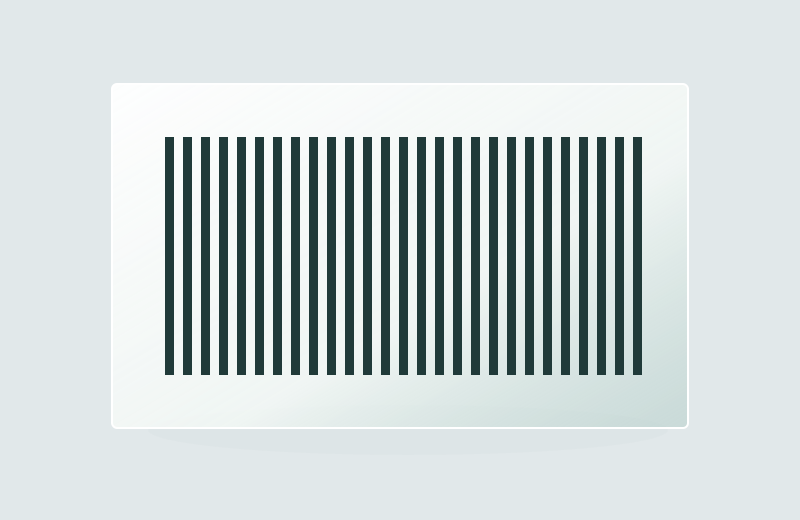
A Ronchi ruling is a binary periodic pattern, commonly with equal opaque and clear widths. Define pitch as one complete dark-plus-clear period. For pitch p in millimetres, spatial frequency is 1/p line pairs per millimetre.
Useful for focus comparison and periodic-pattern response, and in compatible Ronchi optical test arrangements. The instrument layout determines how the observed bands are interpreted.
A fixed period lets you compare the appearance of the same detail under different optical settings.
In a Ronchi optical test, the observed bands depend on grating placement and the optical geometry; that setup is distinct from imaging the printed stripes.
| Choice | Selection basis |
|---|---|
| Pitch or frequency | State whether the unit counts line pairs or individual lines. One period includes a dark line and an adjacent clear space. |
| Duty cycle | A 50% duty cycle gives equal line and space widths; other ratios change the pattern waveform. |
| Direction and usable field | Match stripe orientation and active area to the test geometry and illuminated field. |
Fixed-pitch periodic lines for optical tests.
Measure pitch, line width and duty cycle across the active area; check for interruptions and local defects.
A glass ruling is supplied with the selected period, duty cycle, direction and active area, with pitch and feature inspections defined for that pattern.
No. Chrome rulings modulate transmitted amplitude. A phase grating instead requires a specified optical-path or relief structure.
Ronchi rulings use equally spaced parallel stripes as periodic and directional references for optical testing.
State pitch and line width with the frequency convention. Sampling, focus and illumination influence the captured pattern.
Pitch or frequency, line width, duty cycle, orientation, field and polarity.
State whether the count means individual lines or complete light-and-dark periods. Giving pitch and line width avoids ambiguity.