
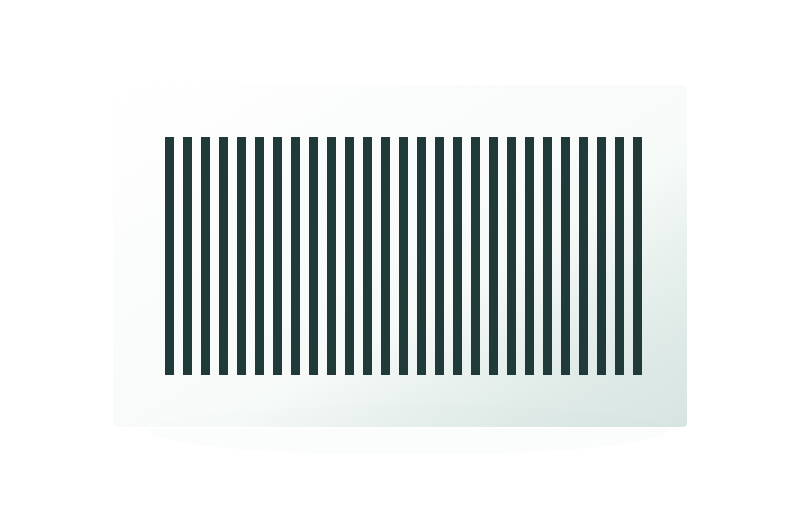
Chrome Amplitude Gratings

Control the periodic bright and dark pattern.

Binary amplitude gratings made from periodic chromium lines on glass for optical modulation, diffraction experiments and custom instruments.

Chrome Amplitude Gratings

Product selection

What it is and what it does

Alternating opaque and clear regions modulate transmitted amplitude. Pitch, duty cycle and illuminated aperture determine the geometric pattern; diffraction efficiency also depends on wavelength, illumination and the optical setup.

When to choose it

Use a periodic chrome pattern to modulate light for sensing or an optical reference. Choose a Ronchi target when the main task is a standard periodic focus or imaging test.

Product selection and delivery

How it differs from related products

An amplitude grating modulates transmitted intensity with clear and opaque stripes. A phase grating instead changes optical phase through relief or refractive-index structure. Similar periods do not make their efficiency or diffraction behaviour interchangeable.

What can be customised

Period, duty cycle, stripe direction, active area and reference marks can be combined; the useful wavelength and illumination determine how the grating is used.

What you receive

A patterned glass reference component with the selected graduations, outline and mounting dimensions, accompanied by the specified inspection records.

Specifications and inspection

Product configuration

Chrome Amplitude Gratings
Period and duty cycleSpecify clear width and repeat spacing independently
Grating directionStripe orientation relative to mounting datums
Illuminated fieldUsable grating area and edge exclusions

Inspection requirements

Inspect period, linewidth, defects and pattern orientation. Define any diffraction-efficiency measurement with its wavelength and geometry.

How an amplitude grating works

Alternating opaque and clear stripes vary the transmitted optical field across the grating. Period and duty cycle define the geometry. Under suitable illumination the periodic structure produces diffraction orders; their intensity distribution depends on the optical setup as well as the pattern.

Match the grating to the measurement

Use a periodic pattern for spatial modulation, optical sensing or a defined line reference. Specify the illuminated area and stripe direction together with pitch. If the main task is visual focus or resolution comparison, a Ronchi ruling may be the clearer product choice.

Separate amplitude and phase designs

This product controls transmission through film geometry. It does not specify a relief profile or a phase delay. A required diffraction angle or efficiency must be evaluated at the wavelength, incidence angle and polarization of the intended system.

Pattern and format options

Choose the functional geometry first, then define its size, orientation and mounting relationship.

Parallel stripe grating

One stripe direction and a defined repeat period.

Custom duty-cycle grating

Choose clear width within the required period for the optical design.

Define the component and its inspection

Control itemInformation to confirm
Geometry and position
  • Grating period and duty cycle
  • Active aperture and line direction
  • Operating wavelength and required optical measurement
Substrate and optical pathSpecify glass grade, thickness, wavelength and illumination side. Review transmission and reflections in the actual optical arrangement.
Inspection and acceptanceInspect period, linewidth, defects and pattern orientation. Define any diffraction-efficiency measurement with its wavelength and geometry.
Drawing and revisionProvide a 1:1 DWG with declared units, clear and opaque layers, viewing direction, active area and the approved revision.
Preparing your DWG drawing

Where this product is used

Common questions

Does a chrome amplitude grating replace a blazed grating?

Not directly. A blazed grating uses a shaped structure to redistribute light among diffraction orders. A binary chrome grating has a different optical response.

Related products

Selection notes

Chrome amplitude gratings modulate light with repeating transparent and opaque stripes for optical reading and pattern testing.

Specify period, line width, duty cycle, orientation and usable area independently. Match contrast to the working wavelength.

Information for your inquiry

Pitch, line width, duty cycle, orientation, active area, substrate and optical mode.

Is line width the same as grating pitch?

Pitch is the repeat distance of a complete light-and-dark period. Line width describes part of that period; specify both to define the clear-to-opaque ratio.

Search