What the component does
The scale places a length reference close to the measured motion. Incremental and absolute patterns support different startup and referencing methods.

Measure carriage travel relative to a reference scale instead of relying solely on screw or motor rotation.
This arrangement fixes the scale and moves the reader; some machines use the reverse arrangement.
These are simplified pattern examples, not production encoding artwork or a universal absolute-code format.
The scale places a length reference close to the measured motion. Incremental and absolute patterns support different startup and referencing methods.
Transmissive readers place illumination and detection across the scale; reflective readers use the returned light. Coating and readhead geometry must suit the chosen path.
Thermal expansion, mounting stress and an offset between the scale axis and measurement line can cause errors beyond the graduation itself.
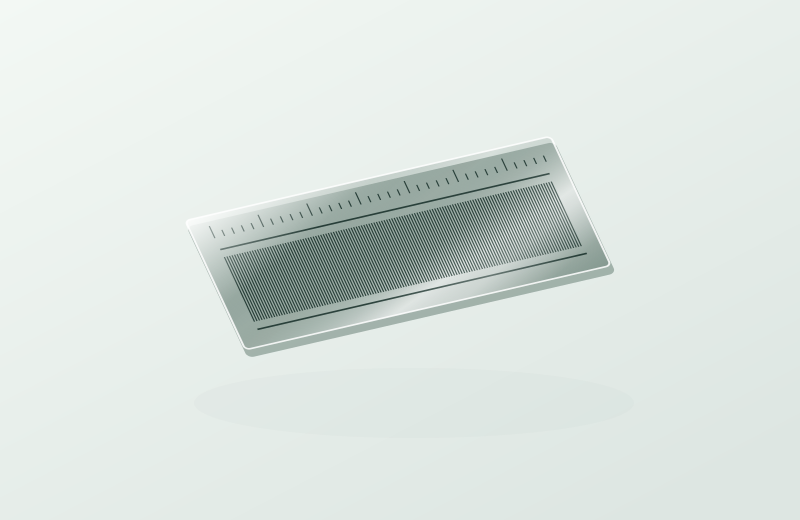
Periodic scale tracks with reference marks for homing.

Position-coded scales matched to a specified decoder.
Choose between incremental and absolute glass scale configurations.
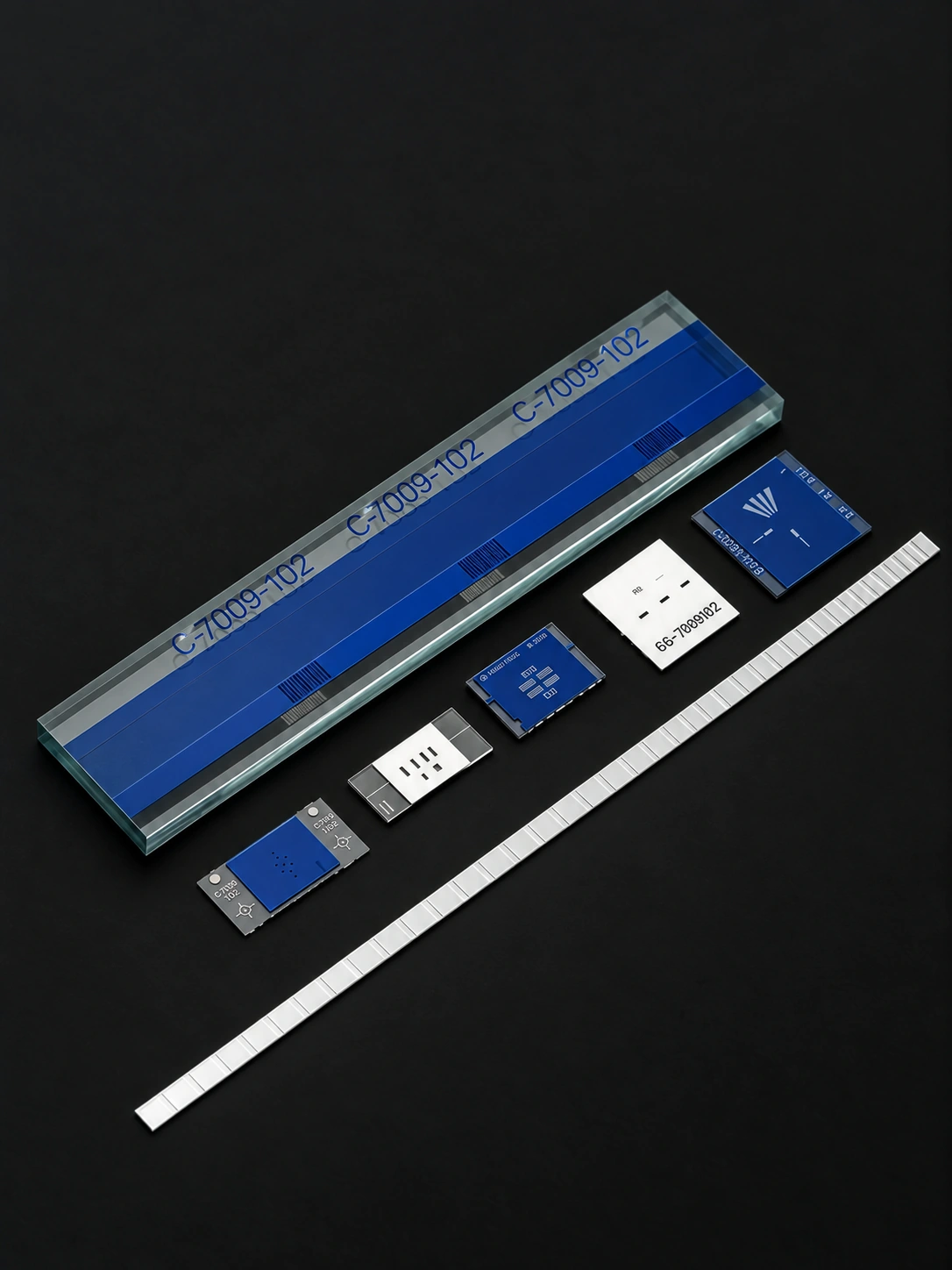
Glass scales for a readhead with optical access to both sides.
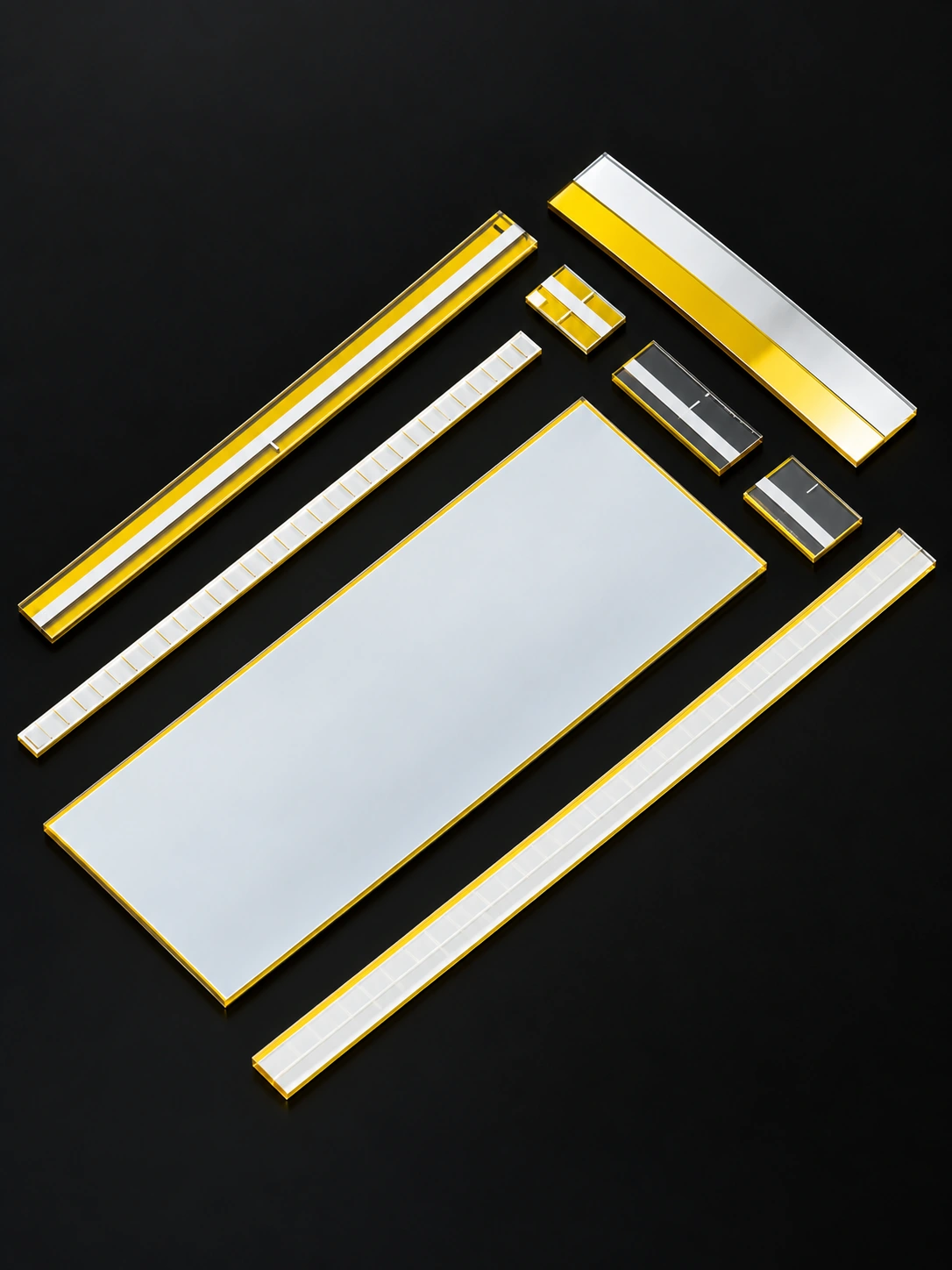
Reflective patterns for compatible readheads on one side of the scale.
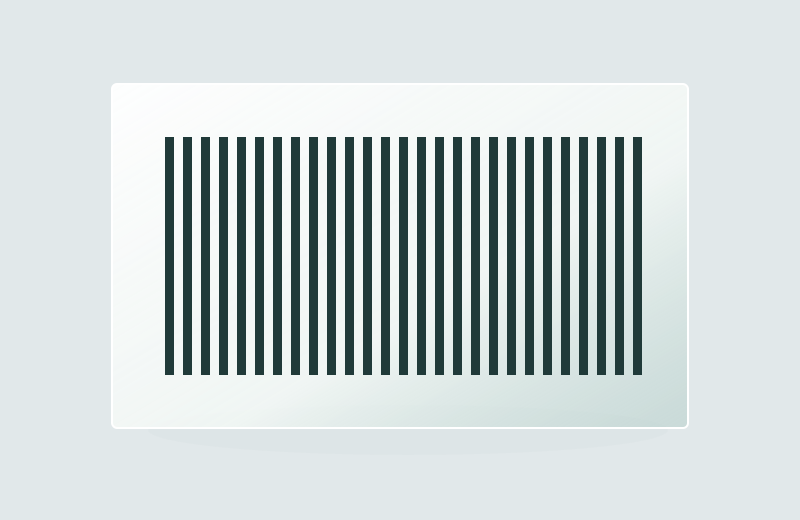
Custom periodic glass patterns for a compatible optical readhead design.
A patterned scale is mounted along the measurement axis and read as the carriage moves. Incremental scales provide repeated intervals; absolute scales carry a position code. Typical integration tasks include stage travel measurement, machine-axis feedback and coordinate measurement.
The physical pitch is not necessarily the reported system resolution because interpolation may subdivide each period. Total travel accuracy also depends on cumulative pitch error, glass expansion, mounting stress and alignment of the measuring axis.
A scale can be used to close a positioning loop or independently measure carriage travel. Keep active length separate from overall glass length, and place the measuring reference near the motion of interest where the mechanical design permits.
Glass linear scales provide periodic or absolute position references along a measuring axis.
State overall glass length, active travel, pitch, reference position and mounting datum separately.
Interpolation may produce a smaller output increment. Physical pitch, reported increment and full-travel accuracy are different specifications.