Glass Gobos

Project the artwork carried on glass.

Custom glass gobos carry clear and opaque artwork for projecting logos, lettering, textures and optical reference patterns.

Glass Gobos

Product selection

What it is and what it does

A glass gobo is a patterned optical plate placed at the image gate of a compatible projector. Clear areas transmit light while opaque areas suppress it. The projection lens forms an enlarged image on a wall, floor, stage or work surface. The glass supports isolated details such as the centres of letters without the connecting bridges needed in a cut-metal stencil.

When to choose it

Choose a glass gobo when a fixed design must be projected repeatedly: a logo, sign, scenic texture or alignment mark. For changing digital content, a programmable image projector serves a different need.

Product selection and delivery

How it differs from related products

A glass gobo carries a projected image. A photomask transfers artwork into photoresist, while a viewing reticle supplies a reference within an instrument. Unlike cut-metal gobos, glass can support isolated image details without bridges.

What can be customised

Artwork, clear/opaque polarity, outer diameter, usable image area, thickness, pattern orientation and substrate/coating combination can be defined around the projection fixture.

What you receive

The finished patterned glass gobo in the agreed format. The supply scope identifies any carrier and inspection documentation separately; it does not imply a complete projector.

Specifications and inspection

Product configuration

Glass Gobos
Pattern typeMonochrome clear/opaque artwork
Mechanical formatOutside diameter, thickness and holder clearance
Image fieldUsable diameter, centring and orientation
Optical configurationWavelength, illumination side and fixture conditions

Inspection requirements

Check the artwork revision, clear/opaque polarity, image orientation, outer dimensions, thickness and pattern position. Inspect edge definition, pinholes, scratches and contamination in the usable image area. Optical density and transmission are evaluated at the operating wavelength; projected appearance is checked in a representative optical setup when included in the acceptance scope.

Logo and architectural projection

A fixed logo, monogram or directional symbol can be projected without attaching a printed sign to the receiving surface. Artwork readability depends on viewing distance, projection angle, ambient light and background texture. A design that looks clean on a screen may need wider gaps or simpler detail to remain legible in the installed projection.

Stage textures and repeated patterns

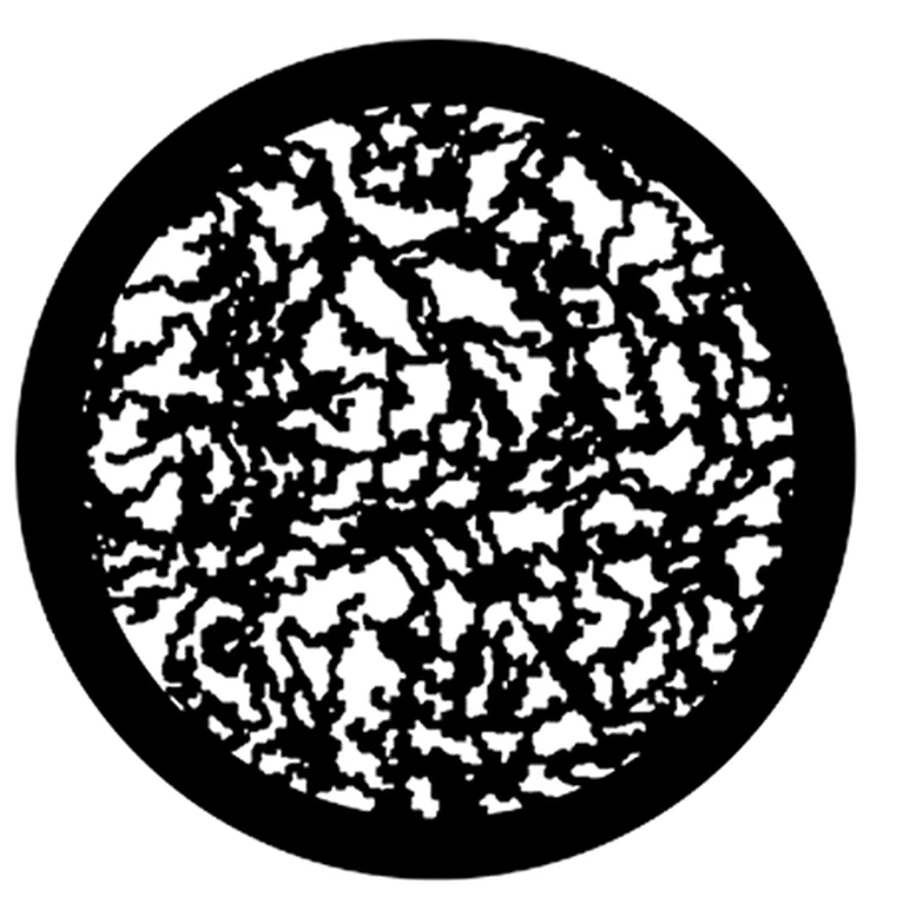
Branch silhouettes, window shapes and abstract textures shape the illuminated scene. A fixed or rotating holder changes how the pattern is presented. Glass artwork defines the pattern; rotation, focus and movement come from the fixture. Fine repeated features must remain compatible with the lens and intended degree of defocus.

Projected references for optical instruments

Crosses, lines and other reference shapes can be projected onto a work surface for positioning or alignment in a purpose-designed instrument. Their position depends on the complete optical arrangement and mounting. For dimensional measurement, a calibrated target and a defined measurement procedure are needed; a projected symbol alone is not a traceable dimensional standard.

Separate the glass size from the image size

Outside diameter and thickness control mechanical fit. The usable image diameter is the area the fixture can illuminate and project without clipping. Pattern centring and orientation determine where the image appears. Keeping these dimensions separate prevents a physically fitting gobo from losing part of its artwork at the aperture.

Match the substrate and coating to the light

Glass grade, coating absorption and reflected light affect how a gobo behaves in a fixture. Wavelength, beam concentration, cooling and exposure duration matter alongside lamp power. A design qualified for one light source should not be assumed suitable for a hotter or more concentrated beam.

From approved artwork to a repeatable component

For monochrome artwork, the design separates transmitting and blocking regions. Orientation is approved from a declared viewing side so lettering is not mirrored in the intended projection. The deliverable is the patterned glass component in the agreed format; a projector, lens or mounting carrier is included only if separately specified.

Pattern and format options

Choose the functional geometry first, then define its size, orientation and mounting relationship.

Logo and lettering gobos

Isolated letter details and custom symbols supported by glass.

Texture and breakup gobos

Repeated or irregular patterns for shaping a projected scene.

Reference-pattern gobos

Lines, crosses and custom shapes for a compatible projection instrument.

Define the component and its inspection

Control itemInformation to confirm
Geometry and position
  • Outer diameter and holder thickness
  • Usable image diameter and pattern polarity
  • Projection orientation and smallest artwork details
Substrate and optical pathSpecify glass grade, thickness, wavelength and illumination side. Review transmission and reflections in the actual optical arrangement.
Inspection and acceptanceCheck the artwork revision, clear/opaque polarity, image orientation, outer dimensions, thickness and pattern position. Inspect edge definition, pinholes, scratches and contamination in the usable image area. Optical density and transmission are evaluated at the operating wavelength; projected appearance is checked in a representative optical setup when included in the acceptance scope.
Drawing and revisionProvide a 1:1 DWG with declared units, clear and opaque layers, viewing direction, active area and the approved revision.
Preparing your DWG drawing

Where this product is used

Common questions

Is a glass gobo a lens?

It is the image-bearing pattern in the projector. The projection lens focuses and magnifies that pattern onto a surface; the gobo itself does not replace the lens.

Can the same gobo fit any projector?

No. Holders differ in diameter, allowable thickness, retention method and image opening. Optical and thermal conditions also differ. A matching outside diameter alone does not establish compatibility.

How are colour and grayscale images different?

A monochrome gobo controls where light passes. Halftone screening can represent tonal variation if the projector resolves the pattern appropriately. Full-colour gobos commonly use patterned dichroic layers and require a separate coating and assembly assessment; they are not a default option for chrome-on-glass artwork.

Does a smaller feature guarantee a sharper projected image?

No. Lens performance, focus, magnification, illumination and the receiving surface all affect the result. Small pinholes, edge defects and contamination can also become conspicuous when magnified. Component inspection and a projection check answer different questions.

Related products

Selection notes

Glass gobos use optical patterns on glass to project logos, lettering or graphics onto a surface.

Match actual pattern dimensions, clear and opaque areas, minimum details and mirror direction to the projector optics.

Information for your inquiry

Vector artwork, projected role, plate outline, active image area, smallest feature and viewing side.

Can a design-software image be used directly for manufacture?

Confirm physical size, polarity, minimum details and orientation before releasing the manufacturing artwork.

Search