
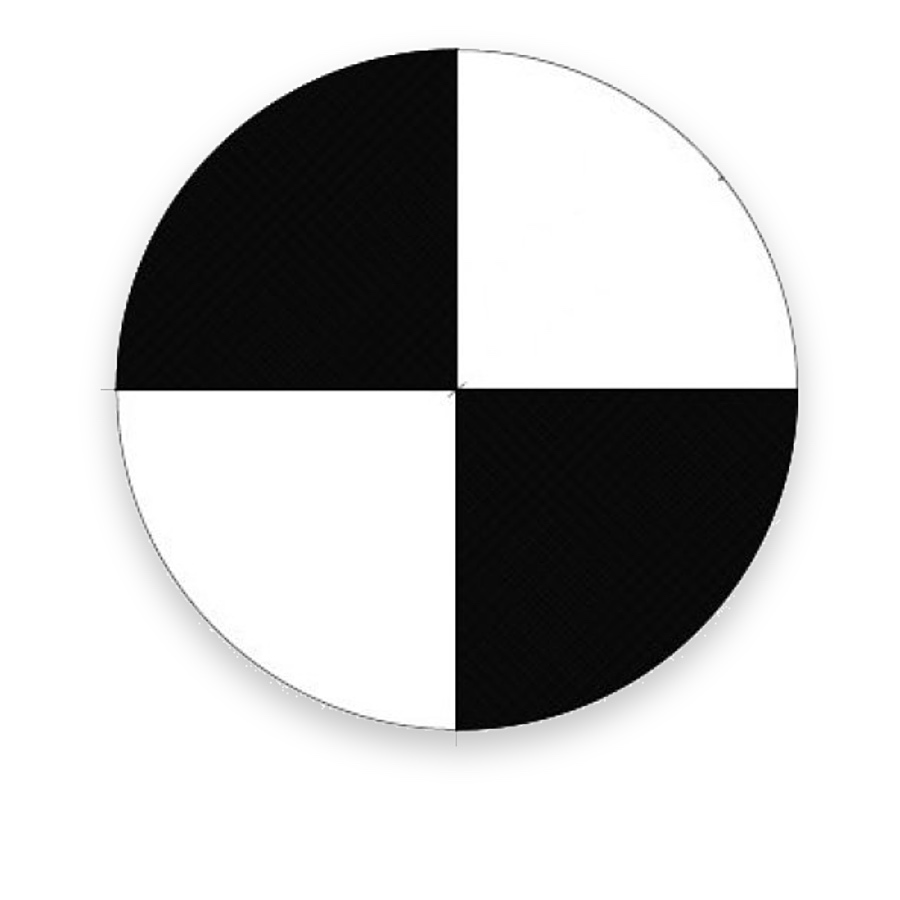
Quadrant Alignment Reticles

Alternating opaque and clear quadrants meet at a defined centre. The intersecting boundaries provide horizontal and vertical edge references.

Quadrant Alignment Reticles

Configuration and materials

Specify optical glass or fused silica, overall dimensions, thickness, pattern-side orientation and the clear aperture. Define transmission, reflectance or optical density at the working wavelength when optical contrast is critical.

  • Active field, scale or feature geometry and optical-plane location
  • Material, outside dimensions, thickness and mounting datums
  • Working instrument, illumination and viewing side
  • Critical tolerances, inspection intervals and reporting needs

Using the reference in the instrument

Recognise the direction of an offset

Four sectors help an operator distinguish left/right and up/down displacement during centring. Sector symmetry and the centre opening affect how a target can be compared with the reference.

Optical references in measuring instruments

An optical reference, rather than a detector

The glass supplies visible boundaries. A quadrant photodiode instead measures light in four sensing areas and produces electrical signals; the two parts have different functions even when their layouts look similar.

Position the pattern at the intended focal plane

Choose by function

What it is and what it does

Alternating opaque and clear quadrants meet at a defined centre. The intersecting boundaries provide horizontal and vertical edge references.

When to choose it

Use alternating quadrants for centring and directional alignment where a sharp contrast transition around the common intersection is useful.

How it differs from related products

A quadrant reticle divides the optical field into directional reference sectors. It supplies visible geometry; a quadrant photodetector supplies electrical measurements from separate sensing areas.

What can be customised

Line width, centre opening, axis length, orientation marks and mounting diameter can be matched to the visible field.

What you receive

A patterned glass reference component with the selected graduations, outline and mounting dimensions, accompanied by the specified inspection records.

Where this product is used

Pattern and format options

Quadrant Alignment Reticles — Pattern 046

Pattern 046

Related pattern choices

Selection notes

Quadrant alignment reticles divide the field around a centre to support position, axis and offset assessment.

Define quadrant boundaries and the central reference for the optical task; relate them to the mounting datum.

Information for your inquiry

Quadrant layout, centre, gaps, line width, active field, film side and outline.

How do quadrant patterns differ from a crosshair?

A crosshair gives centre and direction. Quadrant structures also distinguish regions, helping judge which way a target is displaced.

Search