Applications and compatible instruments
For optical focus checks, visual resolution comparisons and periodic-response tests in cameras, microscopes and imaging lenses.

Line-Pair Grating Target R25: For optical focus checks, visual resolution comparisons and periodic-response tests in cameras, microscopes and imaging lenses.
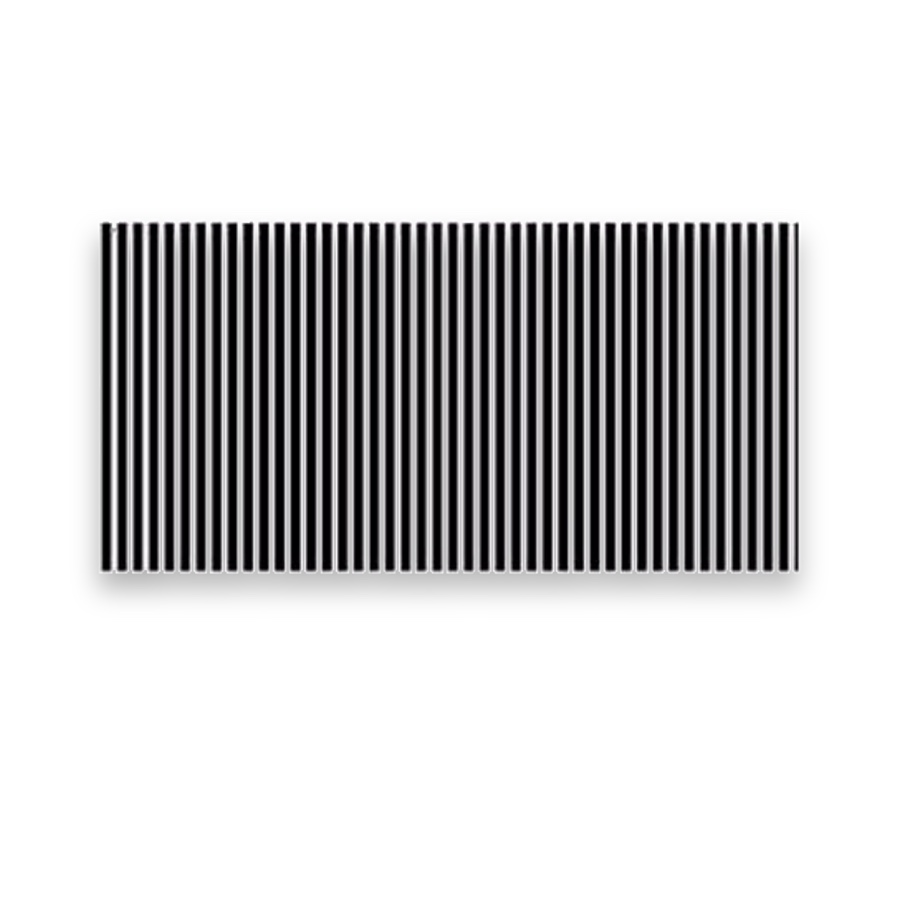
Alternating opaque and clear bands form a binary amplitude grating. One line pair is a complete dark-plus-clear period.
Useful for focus comparison and periodic-pattern response, and in compatible Ronchi optical test arrangements. The instrument layout determines how the observed bands are interpreted.
Ronchi rulings repeat a fixed line-and-space period; a USAF chart steps through labelled frequencies, while a star changes frequency with radius. Binary line contrast contains harmonics and is not directly the sinusoidal MTF.
Line period, duty cycle, line direction, useful area and polarity define the main options.
A glass target in the selected pattern, polarity and substrate format, with the dimensional inspection or calibration records included in the order.
For optical focus checks, visual resolution comparisons and periodic-response tests in cameras, microscopes and imaging lenses.
Inspect line width, pitch, duty cycle, orientation and missing or bridged features across the usable field.
Quality & Inspection PhotolithographyCompare focus and resolved detail with this optical test pattern.
For pitch p in millimetres, frequency is 1/p line pairs per millimetre. At 50% duty cycle each bar and gap is p/2. State whether frequency refers to the target or image plane.
Line-Pair Grating Target R25: For optical focus checks, visual resolution comparisons and periodic-response tests in cameras, microscopes and imaging lenses.
Match this artwork reference to its labelled dimensions, polarity and active field. The product image, manufacturing artwork and inspection drawing should identify the same revision.
Artwork reference, labelled geometry, active area, substrate outline, illumination and inspection requirements.
Use the pattern reference and its specific geometry, labels and intended measurement. A similar outline or photograph does not establish the same frequency, coordinates or reading convention.