
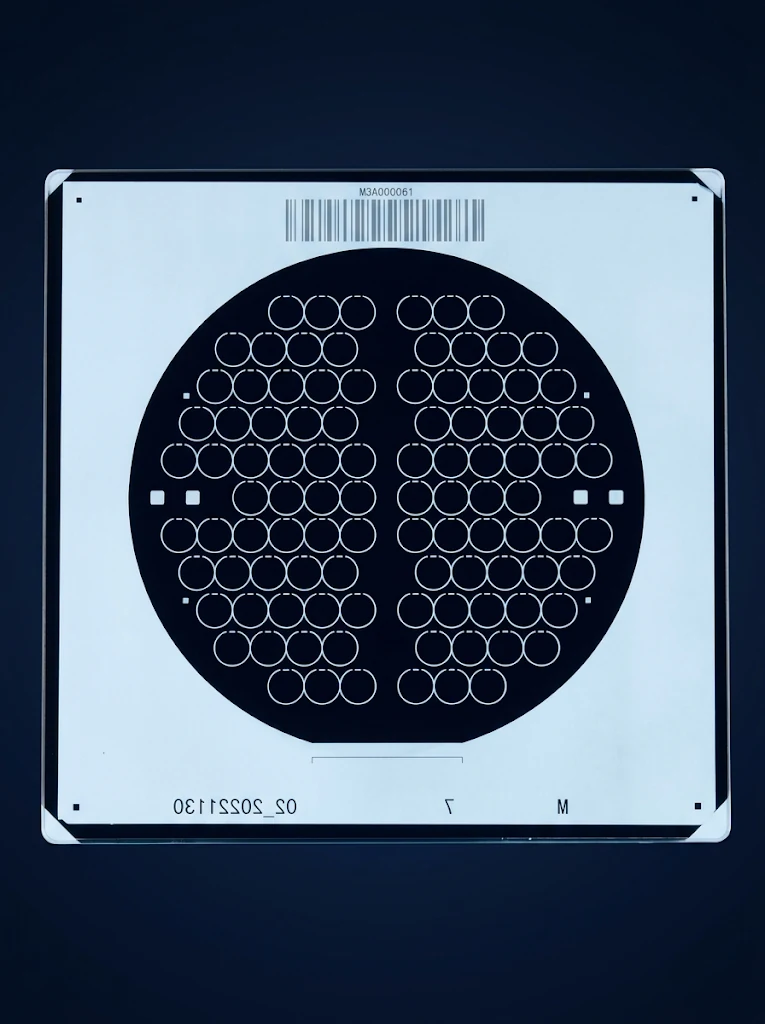
Chrome-on-Glass Photomasks

Pattern transfer starts with the mask.

Finished photomaskCustom formats

Product selection

What it is and what it does

A finished chrome-on-glass photomask uses transparent windows and opaque chromium to form an exposure image. It transfers geometry through a photoresist process; the mask is the reusable pattern source, not the processed workpiece.

When to choose it

Choose a physical mask when the same layout will be exposed repeatedly, or when the exposure tool uses masks to align successive layers. It can support prototypes as well as repeated production.

How it differs from related products

A finished chrome-on-glass mask already carries the exposure pattern; a chrome blank does not. Compared with fused silica, other optical glasses can be suitable when the wavelength and thermal budget do not require the silica route.

What can be customised

Clear-field or dark-field layout, repeat arrays, marks, substrate outline and the contact or proximity use mode can be combined.

What you receive

The product is a patterned glass or fused-silica mask, or an identified set of masks for successive layers. Exposure equipment, photoresist-coated workpieces and the finished devices are separate from the mask itself. Inspection records and packaging form part of the order specification.

Specifications and inspection

Product configuration

Chrome-on-Glass Photomasks
Product configurationFinished binary chrome-on-glass photomask
Pattern definitionClear and opaque regions to approved artwork
Writing referenceConfiguration I / II / III selected around feature size and field
Exposure routeContact, proximity or other specified exposure method
Acceptance focusCritical dimensions, placement, polarity and clear/opaque defects

Inspection requirements

Check critical dimensions, placement, clear defects, opaque defects and pattern orientation against the approved artwork.

Patterned chromium on glass for optical pattern transfer. Specify clear and opaque regions, minimum feature size, pattern orientation and the exposure wavelength.

Built for your process.

Request a Quote
Chrome-on-Glass Photomasks

A physical master for pattern transfer

A chrome photomask divides the exposure field into transparent and opaque regions. In a compatible lithography process, light passing through the mask changes the photoresist so later development and processing can form the required geometry. The mask carries the design; the exposure process determines how it is reproduced.

Why use a stable glass pattern?

A reusable glass master helps repeat the same artwork for optical components, sensor features and other patterned layers. Alignment marks, identification and polarity can be included with the functional geometry. It is different from an unpatterned chrome blank, which still needs the mask-writing process.

Fine chrome patterns on a stable glass mask.

The Heidelberg direct-writing route is suited to binary chrome-on-glass masks where clear and opaque regions must follow an approved artwork. The selected writing configuration, resist stack and chrome etch bias are reviewed together before release.

What this capability enables

  • Fine line/space patterns for optical pattern transfer
  • Clear/opaque polarity and pattern-side orientation controlled from the drawing
  • Feature placement, CD and defect inspection tied to the approved artwork revision

Substrate & optical configuration

Choose glass or synthetic fused silica around the exposure wavelength, thermal requirements and fixture. State chromium optical density, reflectance, film-side orientation and allowed defect classes. The clear and opaque regions must be unambiguous in the approved artwork.

Quality & Inspection Photolithography

Where this product is used

Common questions

What does positive or negative mean on a photomask?

Terminology can depend on the exposure workflow. Provide a marked drawing showing exactly which regions must be clear and which must remain chrome.

Selection notes

Chrome-on-glass photomasks carry artwork as transparent and opaque regions for optical exposure and pattern transfer.

Confirm polarity, line width, spacing, viewing direction, exposure area and wavelength. Keep pattern and mechanical drawings on the same revision.

Information for your inquiry

Artwork, exposure method, wavelength, substrate thickness, film-side orientation, active area and quantity.

How do artwork direction and exposure direction relate?

Specify the viewing side and which way the patterned surface faces, including right-reading or mirrored artwork. The same pattern appears reversed when viewed from opposite sides.

Search