
Large-Area Photomasks

A larger field, controlled from the drawing.

Finished photomaskCustom formats

Product selection

What it is and what it does

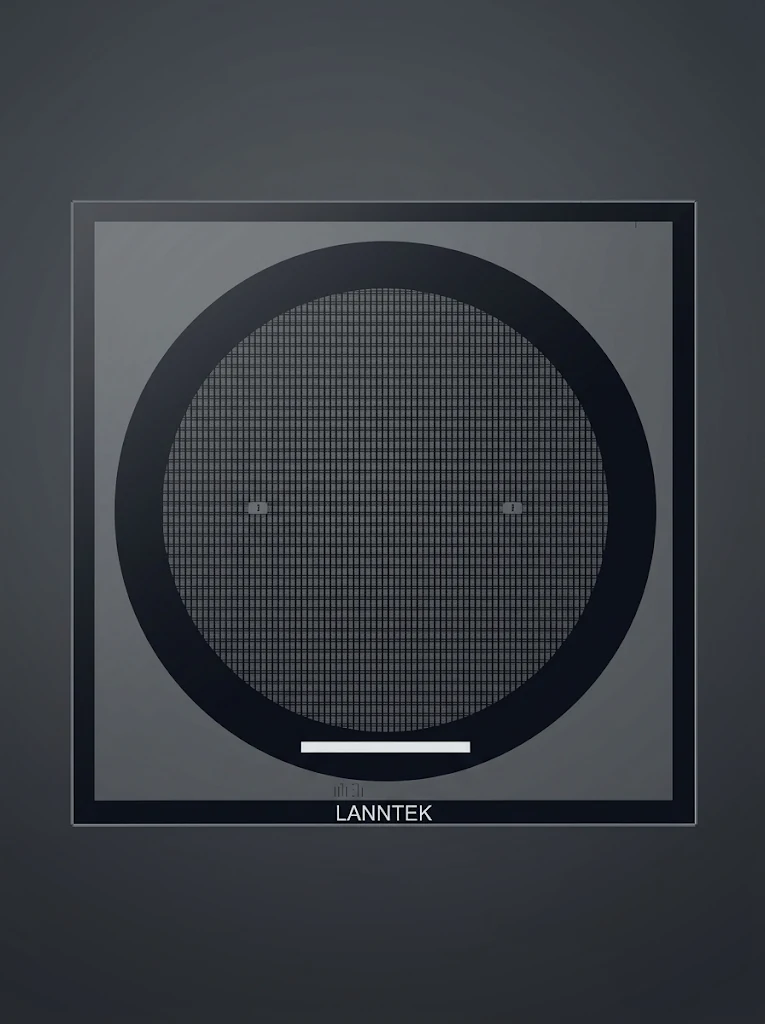
A large-area photomask carries an extended active field on one substrate. It can contain a single large structure or an array of repeated units whose positions share a common coordinate reference.

When to choose it

Choose it when a panel, repeated array or long layout should be exposed in a common field compatible with the tool, rather than assembled from separately positioned exposures.

How it differs from related products

Large area describes field coverage. It can be combined with a glass or fused-silica substrate and with one mask or a multilayer set. Across a wider field, support, flatness and thermal expansion affect registration as well as local line quality.

What can be customised

Active field, repeated cell arrangement, border clearances, handling outline and distributed alignment marks are the main configuration choices.

What you receive

The product is a patterned glass or fused-silica mask, or an identified set of masks for successive layers. Exposure equipment, photoresist-coated workpieces and the finished devices are separate from the mask itself. Inspection records and packaging form part of the order specification.

Specifications and inspection

Product configuration

Large-Area Photomasks
Product configurationLarge-format chrome photomask with a defined active field
Reference fieldUp to 205 × 205 mm or 410 × 410 mm, subject to configuration
Substrate formatUp to 9 × 9 in or 17 × 17 in, subject to fixture
Stitching referenceStitching stability and full-field registration defined on the drawing
Acceptance focusActive-field placement, flatness, stitching and edge exclusion

Inspection requirements

Measure full-field registration, representative critical features, flatness and defects over the agreed active area.

Glass photomasks with an extended patterned area for larger exposure fields. Overall format, usable pattern area and registration requirements must be specified separately.

Built for your process.

Request a Quote
Large-Area Photomasks

Keep a larger pattern in one reference field

A larger mask can carry extended structures, repeated arrays and alignment references within one plate. Typical tasks include compatible display, sensor and patterned-glass processes. The functional area is the region that the exposure system can actually use, not the entire outside dimension.

Uniformity across the whole field

Large fields make substrate shape, coordinate placement and handling more significant. Alignment features should be distributed for the process rather than placed only where there is spare space. Local feature checks and overall registration answer different inspection questions.

Large fields written with controlled stitching.

Large-area masks use the writing field, substrate format and stitching plan as one design problem. The system reference includes exposure fields up to 205 × 205 mm or 410 × 410 mm and substrate formats up to 9 × 9 in or 17 × 17 in, subject to the selected configuration and fixture.

What this capability enables

  • Extended active fields for panel, display and large optical tooling patterns
  • Stitching stability and full-field registration included in the acceptance plan
  • Fixture datums, edge exclusion and active area separated on the drawing

Substrate & optical configuration

Choose glass or synthetic fused silica around the exposure wavelength, thermal requirements and fixture. State chromium optical density, reflectance, film-side orientation and allowed defect classes. The clear and opaque regions must be unambiguous in the approved artwork.

Quality & Inspection Photolithography

Where this product is used

Common questions

Are the substrate outline and patterned area identical?

Usually not. Holding, alignment and edge exclusion can reduce the usable field. Specify both dimensions.

Selection notes

Large-area photomasks carry exposure patterns over an extended substrate for large-field pattern transfer.

Distinguish the substrate outline, active pattern area and location datums. Define alignment and inspection locations across the field.

Information for your inquiry

Overall dimensions, active area, tiled or array relationships, alignment marks, substrate and inspection regions.

Is the whole glass plate an active pattern area?

Not necessarily. Edges may be reserved for handling, cleaning or alignment. Dimension the substrate and usable exposure field separately.

Search