
Polished substrate formats with specified flatness and surface quality.
Precision Glass Substrates
Polished glass substrates for photomasks, reticles and patterned optical components.
Precision starts with the substrate.
Polished surfacesCustom formats
Technical specifications
Precision photomask substrates
| Material | Synthetic fused silica / B270 / soda-lime glass |
|---|---|
| Square formats | 3 / 4 / 6 / 7 / 8 / 9 in |
| Thickness | ≥0.3 mm |
| Total thickness variation (TTV) | ≤2 µm |
| Flatness | ≤2 µm |
Encoder glass substrates
| Material | B270 / K9 / soda-lime glass |
|---|---|
| Maximum diameter | 1500 mm |
| Minimum annular width | 5 mm |
| Thickness | ≥0.4 mm |
| Total thickness variation (TTV) | ≤2 µm |
| Surface figure | λ/4 |
| Concentricity | ≤0.02 mm |
Special-format glass substrates
| Material | K9 / B270 / soda-lime glass / BF33 / D263T |
|---|---|
| Maximum diagonal | 1500 mm |
| Thickness | ≥0.3 mm |
| Total thickness variation (TTV) | ≤2 µm |
| Surface figure | λ/2 |
Polished, unpatterned glass for photomasks, reticles, encoder discs and calibration targets. Select the material and geometry for your next coating or patterning step.
Your pattern. Your substrate.
Request a Quote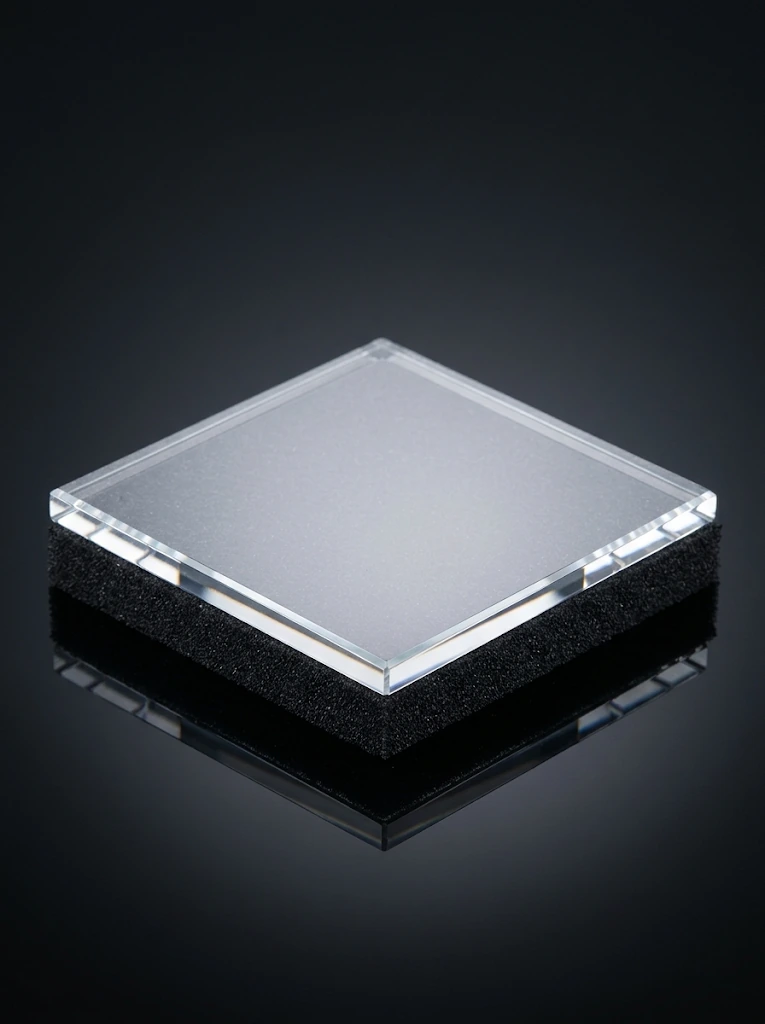
Total thickness variation≤2 µm
TTV specification
Choose by function
What it is and what it does
A precision glass substrate is a polished, unpatterned base for later coating or optical patterning. Its surface supports the film while its geometry locates the eventual component within an instrument or process fixture.
When to choose it
Choose the supply stage that matches the processes you perform in-house: bare glass before coating, chromium-coated glass before resist coating, or a resist-coated plate before exposure.
How it differs from related products
A bare substrate gives you control of the later coating route. A chrome blank already includes the light-blocking film, while a resist-coated blank is prepared one process step further.
What can be customised
Material grade, outline, thickness, polished area and edge finish define the substrate. Coated versions also allow a film stack and resist preparation matched to the downstream exposure and etching process.
What you receive
The supplied item is an unpatterned substrate or coated blank in the selected process state. A finished reticle, encoder track or exposure mask requires a subsequent patterning step. Handling, storage and any accompanying inspection data depend on the selected coating and order.
Where it fits in the process
Choose this starting material when the coating, resist or patterning step will be specified separately. It is the base option for a drawing-led glass component.
Choose the substrate for your wavelength and temperature range
Soda-lime glass is a practical starting material for many visible-light masks and patterned components. Low-expansion glass reduces thermal dimensional change. Fused silica is a strong choice when ultraviolet transmission and low thermal expansion are central requirements. Specify the exact glass grade; borosilicate glass and fused silica are not interchangeable names.
| Substrate material | Typical linear CTE (×10⁻⁶ K⁻¹) |
|---|---|
| Fused silica (quartz glass) | 0.4–0.5 |
| Low-expansion glass | 3.7 |
| Soda-lime glass | 9.4 |
These typical CTE values support material selection. The grade and temperature interval used for a dimensional calculation must be defined on the material specification. A generic low-expansion value does not identify a particular borosilicate grade.
For UV use, specify transmittance at the actual exposure wavelength and substrate thickness. The UV cut-on of soda-lime, white crown and borosilicate glass differs by grade. A thicker substrate can transmit less near its absorption edge; curves measured at different thicknesses are not directly interchangeable.
Small-format substrate flatness options
Choose the format code, glass material and flatness limit together. Each number below is a selectable maximum flatness in micrometres, not a thickness tolerance or a minimum-to-maximum range. These format-based options are separate from the precision-grade specifications above and the coated-blank dimensional schedules.
| Format code | Fused silica: available flatness limits (µm) | Soda-lime: available flatness limits (µm) |
|---|---|---|
| 3004 | Not listed for this format | 5 / 8 / 10 |
| 3006 | Not listed for this format | 5 / 8 / 10 |
| 4004 | 2 / 5 / 6 / 10 | 5 / 8 / 10 |
| 4006 | 2 / 5 / 6 / 10 | 5 / 8 / 10 |
| 4008 | Not listed for this format | 5 / 8 / 10 |
| 4009 | 2 / 5 / 6 / 10 | 5 / 8 / 10 |
| 4010 | Not listed for this format | 5 / 8 / 10 |
| 4012 | Not listed for this format | 5 / 8 / 10 |
| 5002 | Not listed for this format | 8 / 10 / 15 |
| 5004 | Not listed for this format | 8 / 10 / 15 |
| 5006 | 2 / 5 / 6 / 10 | 8 / 10 / 15 |
| 5009 | 2 / 5 / 6 / 10 | 8 / 10 / 15 |
| 6009 | 2 / 5 / 6 / 10 | 10 / 15 |
| 6012 | 2 / 5 / 6 / 10 | 10 / 15 |
| 6023 | Not listed for this format | 10 / 15 |
| 6025 | 2 / 5 / 6 / 10 | 10 / 15 |
| 7009 | Not listed for this format | 10 / 15 |
| 7010 | 2 / 5 / 6 / 10 | 10 / 15 |
| 7012 | 2 / 5 / 6 / 10 | 10 / 15 |
| Property | Specification |
|---|---|
| Edge preparation | Ground edges with a 45° chamfer |
| Edge squareness: linear deviation / reference length | <0.015 in / 1 in |
| Face-to-face thickness difference | |A − B| <5 µm |
The linear squareness option is separate from the 90° ±5′ blank-edge specification. The A/B requirement compares thickness at two specified locations and does not replace a full-aperture TTV measurement. Identify the selected edge specification, measurement positions, clear aperture and flatness test method on the drawing.
Large-format glass substrates
Large-format substrate flatness is specified by plate dimensions and thickness. Use these limits for the listed large-format configurations rather than applying a small precision-substrate flatness value to every plate size.
| Thickness (mm) | Plate-dimension range (mm) | Maximum flatness (µm) |
|---|---|---|
| 3.0 / 4.8 | 228.6 × 228.6 to 508 × 609.6 | ≤70 |
| 3.0 / 4.8 | 609.6 × 609.6 to 700 × 800 | ≤100 |
| 7.8 | 620 × 720 to 700 × 800 | ≤120 |
Specify the required plate dimensions within the listed format ranges, the support condition, measurement area and inspection orientation. The supplied specification should identify whether flatness is assessed before or after coating.
Additional substrate defect grades
Select one substrate acceptance profile for the order. The A/C grades below are separate from the small-format blank defect limits and from the A/B/C chromium-pinhole grades. Substrate defects and coating defects are inspected independently.
| Acceptance grade | Defect type | Defect size, d | Acceptance limit |
|---|---|---|---|
| A | Bubbles | d ≥30 µm | None permitted |
| A | Bubbles | 10 ≤ d <30 µm | ≤1 |
| A | Bubbles | d <10 µm | ≤3 |
| A | Surface pits | d ≥10 µm | None permitted |
| A | Inclusions | d ≥10 µm | None permitted |
| A | Cracks / chips | d >2 mm | None permitted |
| C | Bubbles | d >50 µm | None permitted |
| C | Bubbles | 10 ≤ d ≤50 µm | ≤4 |
| C | Inclusions | d ≥50 µm | None permitted |
| C | Cracks / chips | d >2 mm | None permitted |
Counts refer to defects in the agreed inspection area, not a density per cm². Define the usable area and excluded edges on the drawing. Defect types and size bands not covered by the selected schedule need an explicit acceptance limit.
What can be customized
- Glass type and optical transmission
- Size, thickness, flatness and tolerances
- Surface quality, edge finish and clear aperture
- Cleaning, packaging and inspection records
Where this product is used
Uncoated glass prepared for coating or optical patterning.
Common questions
What is a precision glass substrate?
It is a polished, unpatterned glass component prepared for a later coating or patterning process.
Can the substrate be supplied without a chrome layer?
Yes. Uncoated polished substrates can be specified when the next process will be performed separately.
Which specifications should be included?
Provide material preference, dimensions, thickness, flatness, surface quality, edge condition and any clear-aperture requirement.
Selection notes
Precision glass substrates are dimensioned and surface-finished glass parts for subsequent coating, photolithography or optical assembly.
Select material, thickness, total thickness variation and flatness together. The outer dimensions define the equipment fit; the clear aperture defines the usable optical or processing area.
Information for your inquiry
Glass grade, outline or diameter, thickness, clear aperture, edge finish, TTV and flatness.
How does bare glass differ from a resist-coated chrome plate?
Bare glass has neither chromium nor photoresist. A resist-coated plate already has the film stack needed for a compatible exposure process. Choose the supply state for the next operation you will perform.