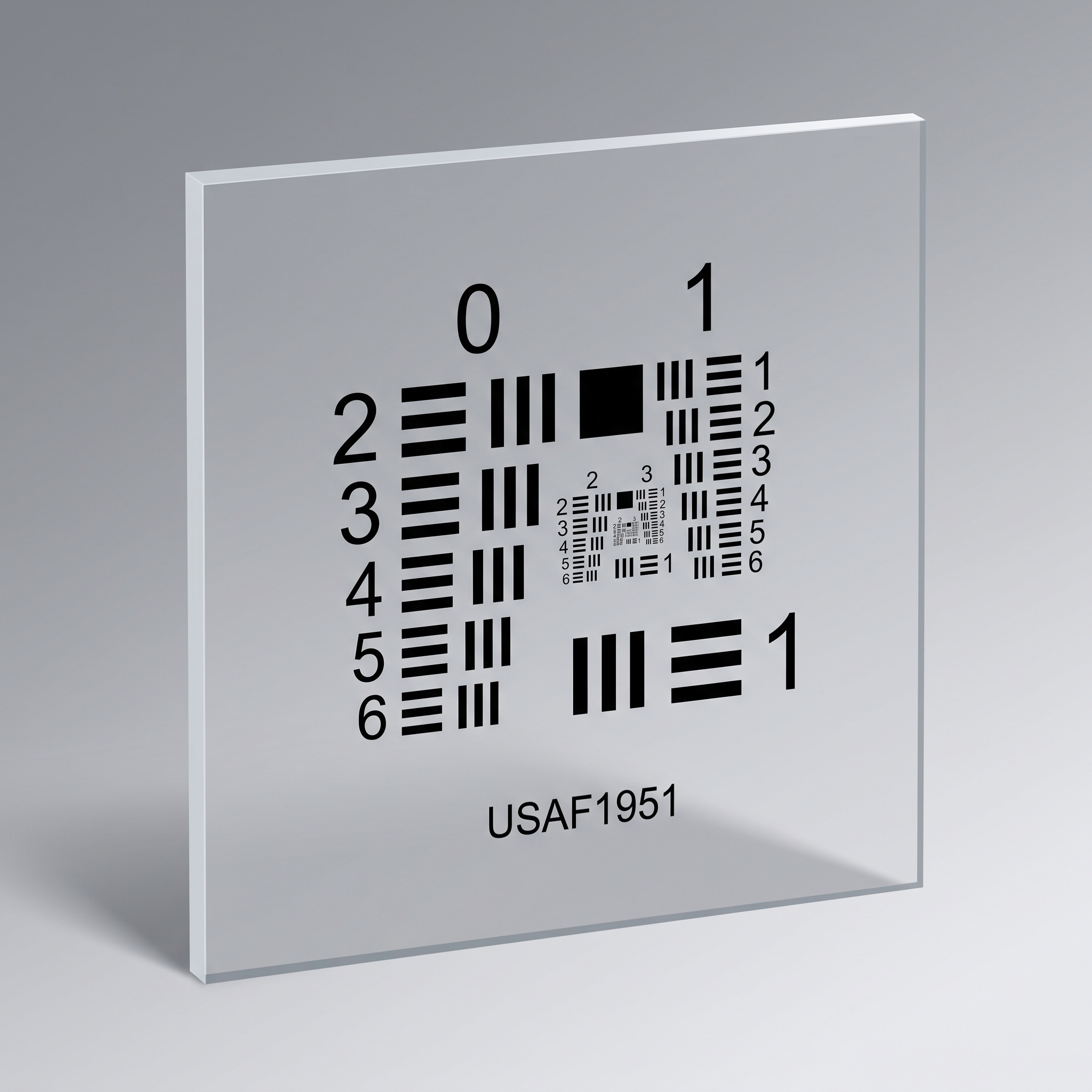
USAF 1951 Resolution Targets
Three-bar USAF 1951 targets for comparing the resolving power of cameras, microscopes and imaging optics. Select the group range, polarity and glass format within one product family.

Line patterns on glass help evaluate an imaging system's ability to resolve detail. Identify the pattern layout, spatial frequency range and illumination mode.
Compare bar patterns for resolved-detail checks, radial stars for directional focus, and slanted edges for software-based SFR/MTF analysis. Pattern geometry, frequency range and illumination should match the measurement method.
Start with the result you need: smallest visible detail, a frequency-response curve, camera geometry or a conversion from pixels to length. Select the pattern for that result before choosing its size.
USAF and NBS support labelled bar readings, stars reveal directional variation and slanted edges support software-derived frequency response. Choose the type around the result your test must report.
Pattern size, feature spacing, polarity, usable field, substrate outline and mounting references can be selected around the camera and illumination. Measured geometry and traceable calibration are separate documentation requirements.
A glass target in the selected pattern, polarity and substrate format, with the dimensional inspection or calibration records included in the order.
Three-bar USAF 1951 targets for comparing the resolving power of cameras, microscopes and imaging optics. Select the group range, polarity and glass format within one product family.
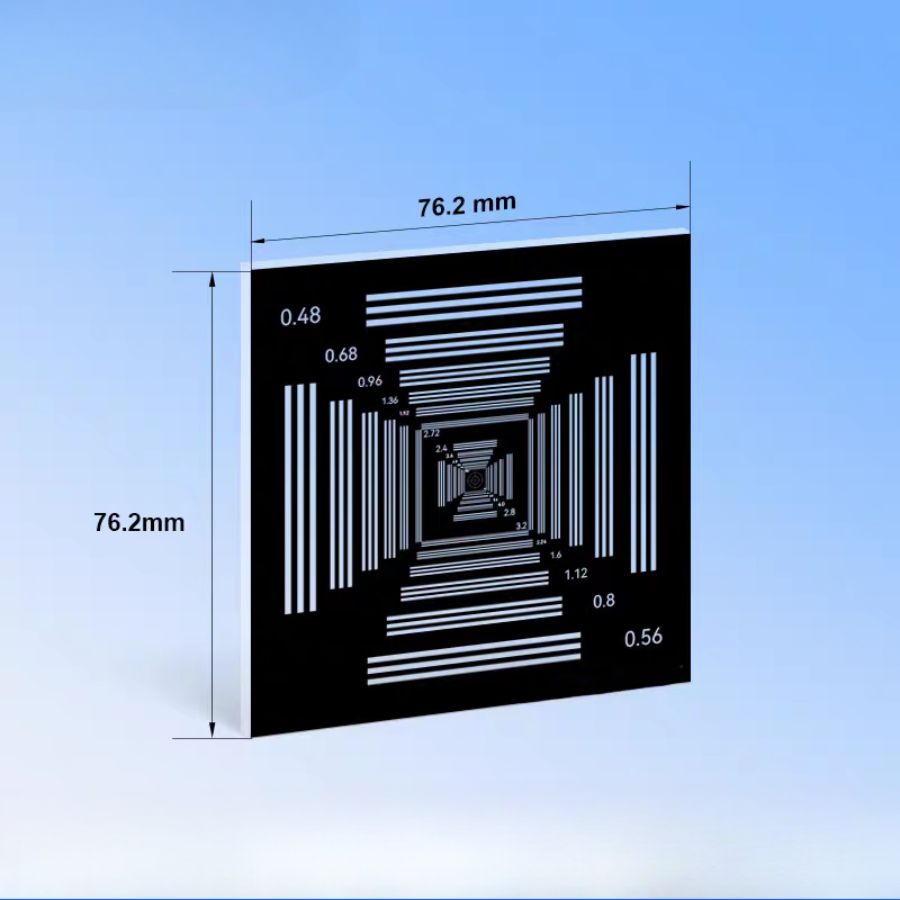
NBS 1952 three-bar resolution targets for lens focus, horizontal and vertical detail checks, and repeatable imaging tests. Explore glass formats, polarity and reading methods.
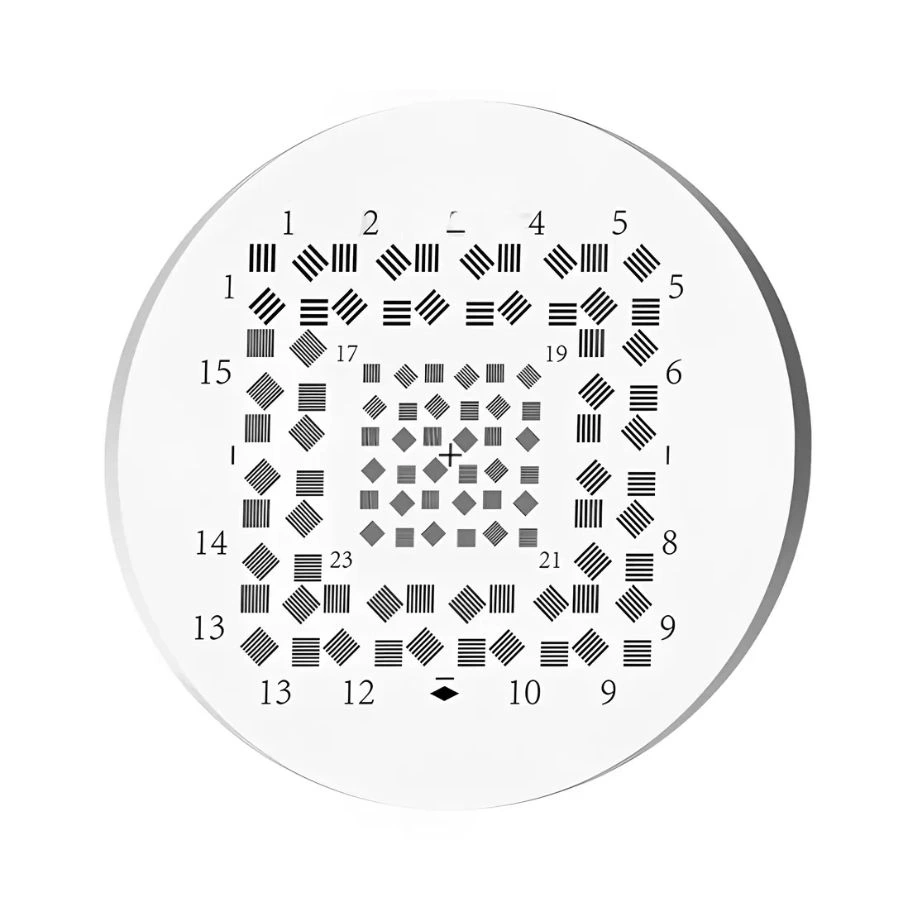
NBS 1963A five-bar resolution targets for ISO 3334-style readings, microscope and scanner testing, and infinity-conjugate collimator setups.
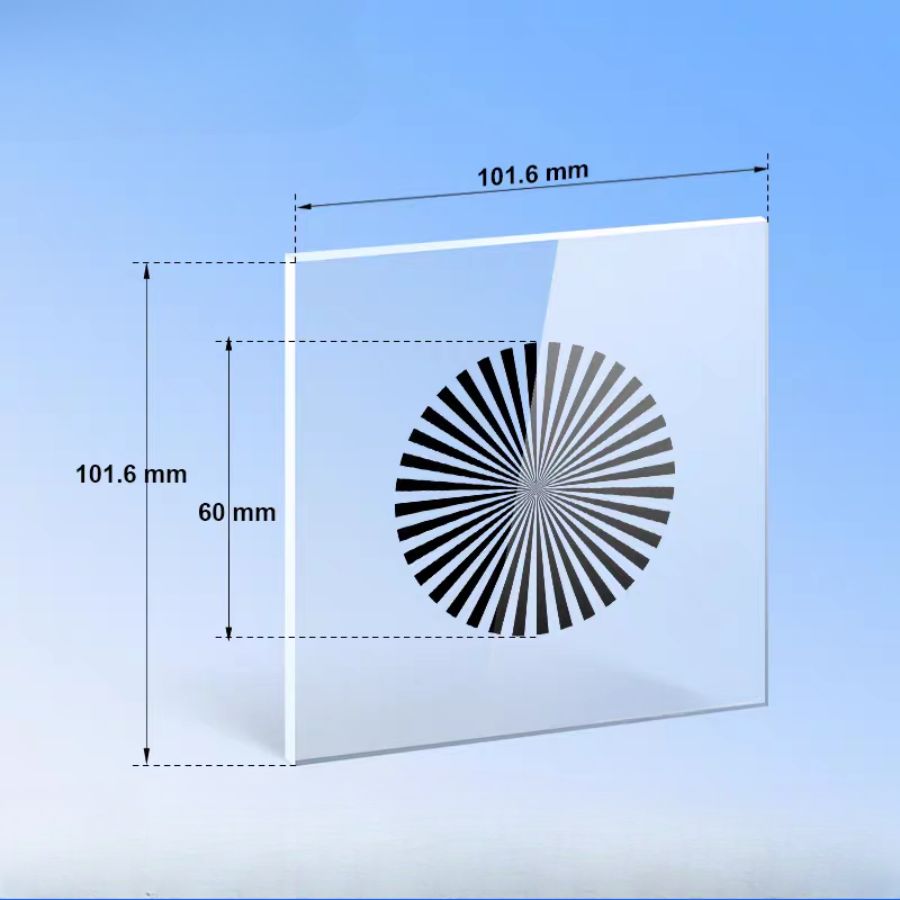
Siemens star resolution targets for lens focus, directional sharpness and imaging-system comparisons. Compare pattern density, usable frequency range and glass formats.
| Product type | When to choose it |
|---|---|
| USAF 1951 Resolution Targets | Choose it for a labelled resolution reading, an assembly focus check or a comparison between optical configurations. Record both bar directions at the working distance and magnification used in the test. |
| NBS 1952 Resolution Targets | Choose it when you need to count resolved bars, compare horizontal and vertical sharpness or track changes during optical adjustment. Its long three-bar groups make line-count errors easier to spot near the resolution limit. |
| NBS 1963A Five-Bar Resolution Targets | Choose it when the procedure calls for an ISO 3334-style five-bar chart, a standardised reading across batches, or a physical target in an infinity-conjugate optical bench. |
| Siemens Star Targets | Choose it for focus adjustment, directional sharpness comparison and repeat checks of cameras, lenses or microscope optics. The usable pattern is the annulus between its defined inner and outer boundaries. |
Compare the available resolution-pattern families.
Choose chrome on transparent glass for backlit transmission. Define dark features on a clear field or clear features in an opaque field explicitly. For reflected-light use, specify the required surface/background reflectance and illumination geometry. Substrate flatness and thickness should match the working field and fixture.
Resolution targets provide known spatial detail for comparing imaging performance.
Select USAF, NBS, Siemens star, Ronchi, Sayce or slanted-edge geometry according to the reading method. Keep visual bar resolution and computed SFR results distinct.
Test method, frequency range, magnification, sensor sampling, polarity and illumination.
Only with a defined common method and conditions. Bar visibility and edge-based response describe different aspects of an imaging system.