Visual resolution readings
Read the finest group whose three bars and separating gaps remain correctly identifiable in each direction.

NBS 1952 three-bar resolution targets for lens focus, horizontal and vertical detail checks, and repeatable imaging tests. Explore glass formats, polarity and reading methods.
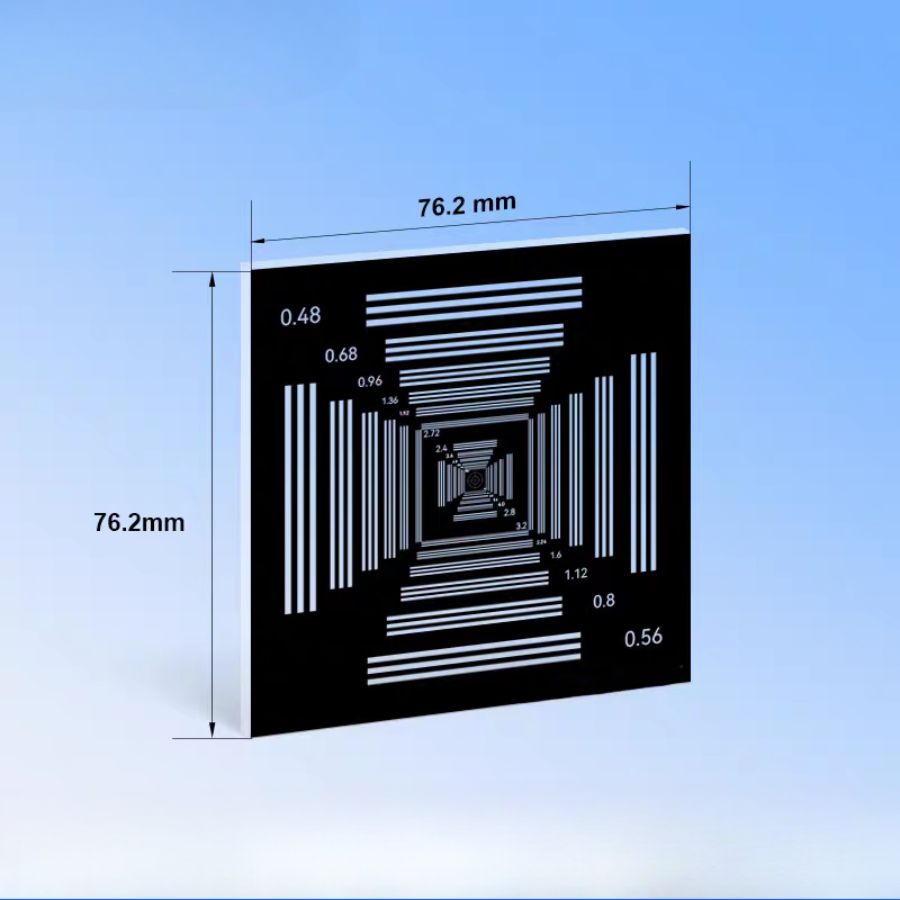
An NBS 1952 target uses groups of three long parallel bars at discrete spatial frequencies. Horizontal and vertical groups are arranged around a common centre, becoming finer towards the middle. It provides a physical reference for the smallest detail an imaging system can reliably separate.
Choose it when you need to count resolved bars, compare horizontal and vertical sharpness or track changes during optical adjustment. Its long three-bar groups make line-count errors easier to spot near the resolution limit.
Read the finest group whose three bars and separating gaps remain correctly identifiable in each direction.
Use NBS artwork when an established fixture or acceptance procedure is based on its bar arrangement and frequency map.
| Choice | Selection basis |
|---|---|
| Frequency map | Use the values defined for the NBS artwork. Its labels are not USAF group and element numbers. |
| Image sampling | Match the finest groups to working magnification; merged or aliased bars are not a valid pass. |
| Polarity and active field | Choose the clear/opaque layout for the illumination and keep the required fields visible in the fixture. |
76.2 mm square
Clear bar groups in an opaque field; the square outline leaves room for edge mounting.
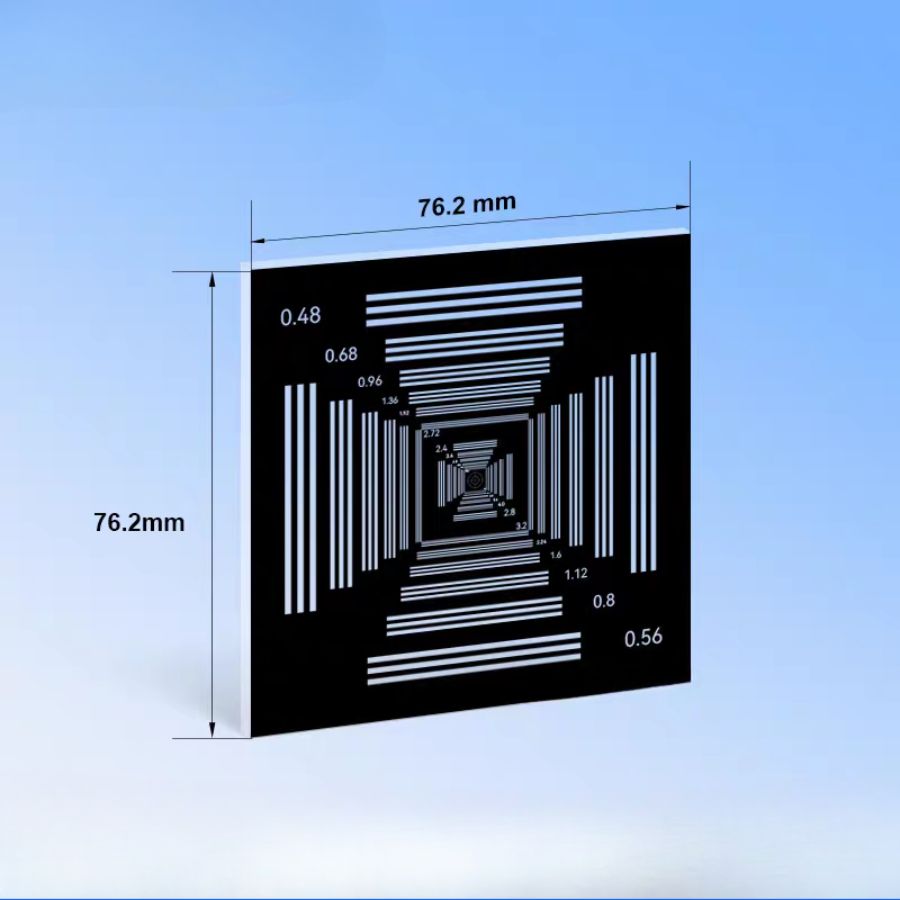
76.2 mm square
Another view of the square opaque-field configuration, showing the frequency labels and central pattern.
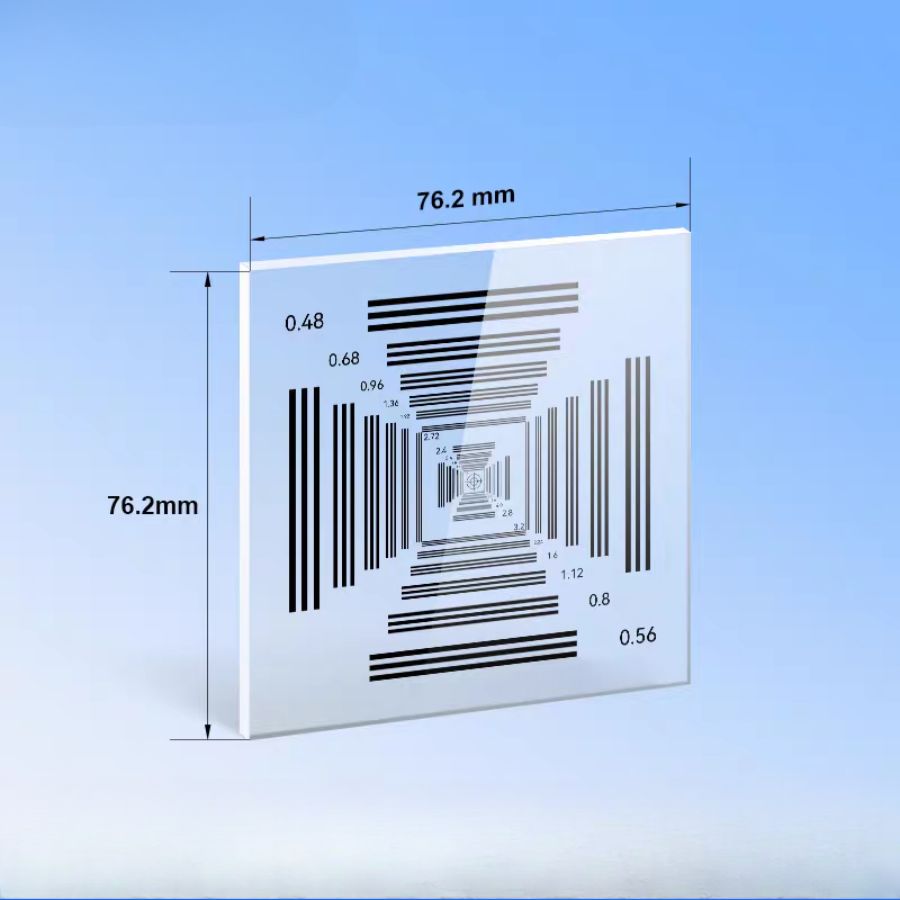
76.2 mm square
Opaque bar groups on clear glass; assess the contrast in the intended illumination setup.
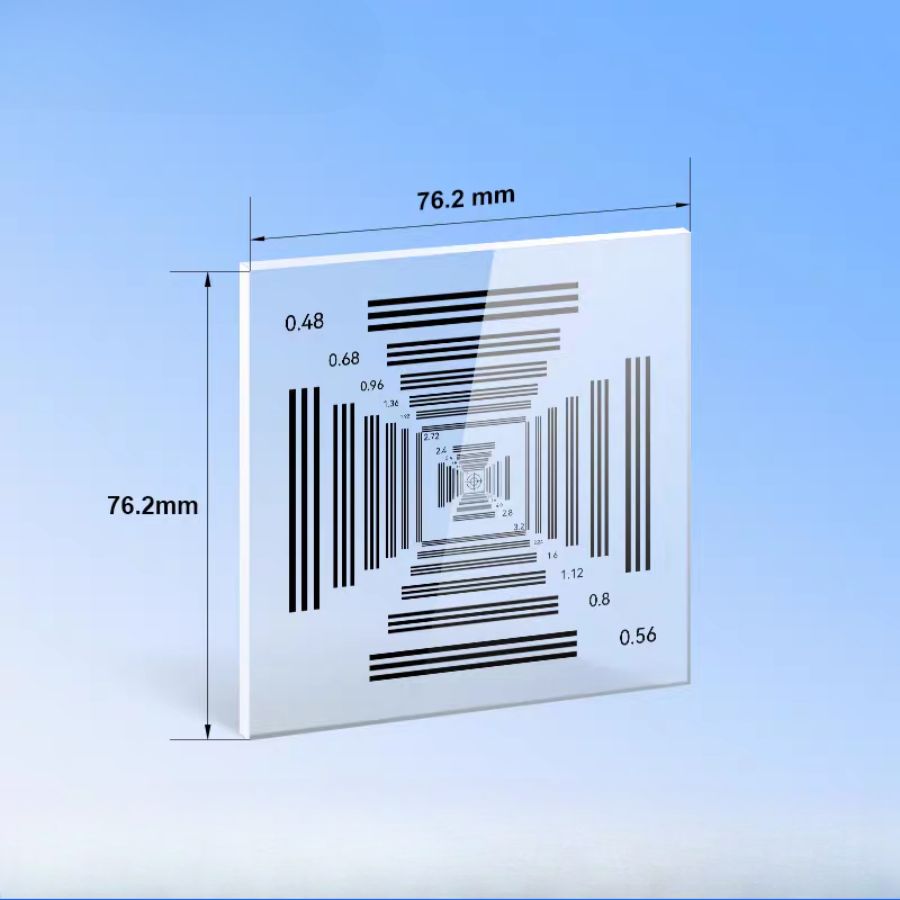
76.2 mm square
Detail of the square clear-field layout, with horizontal and vertical three-bar groups.
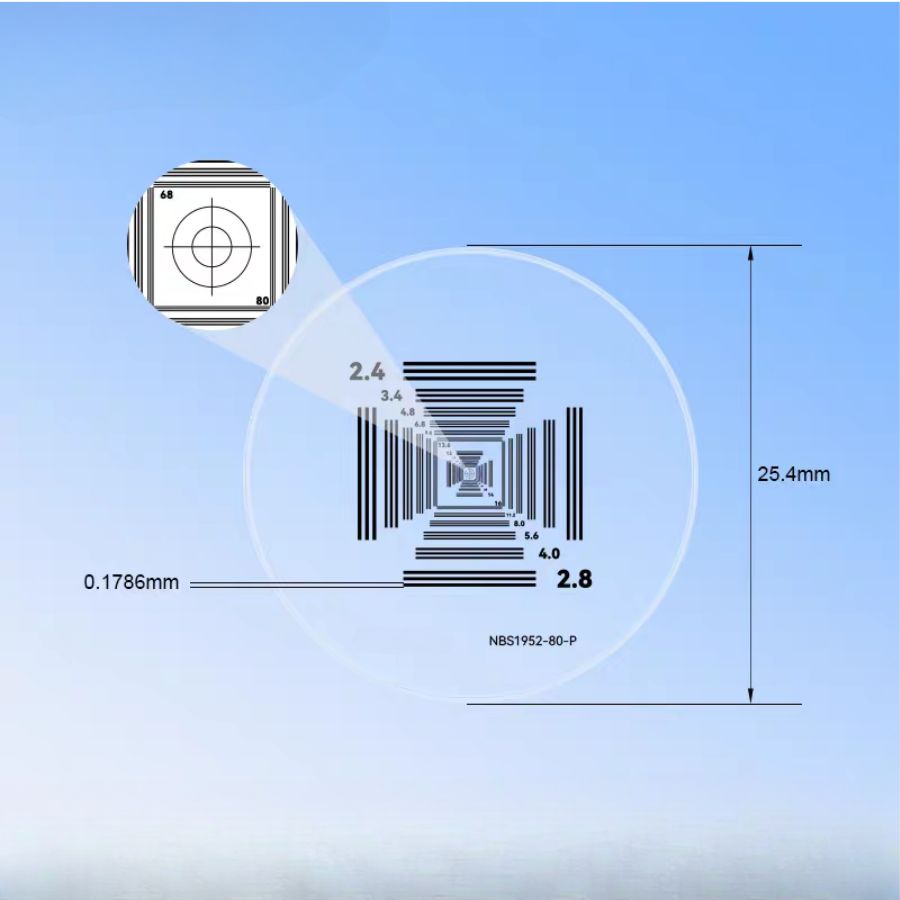
Ø25.4 mm
Clear-field pattern in a round mounting format. The glass diameter and frequency range are separate choices.
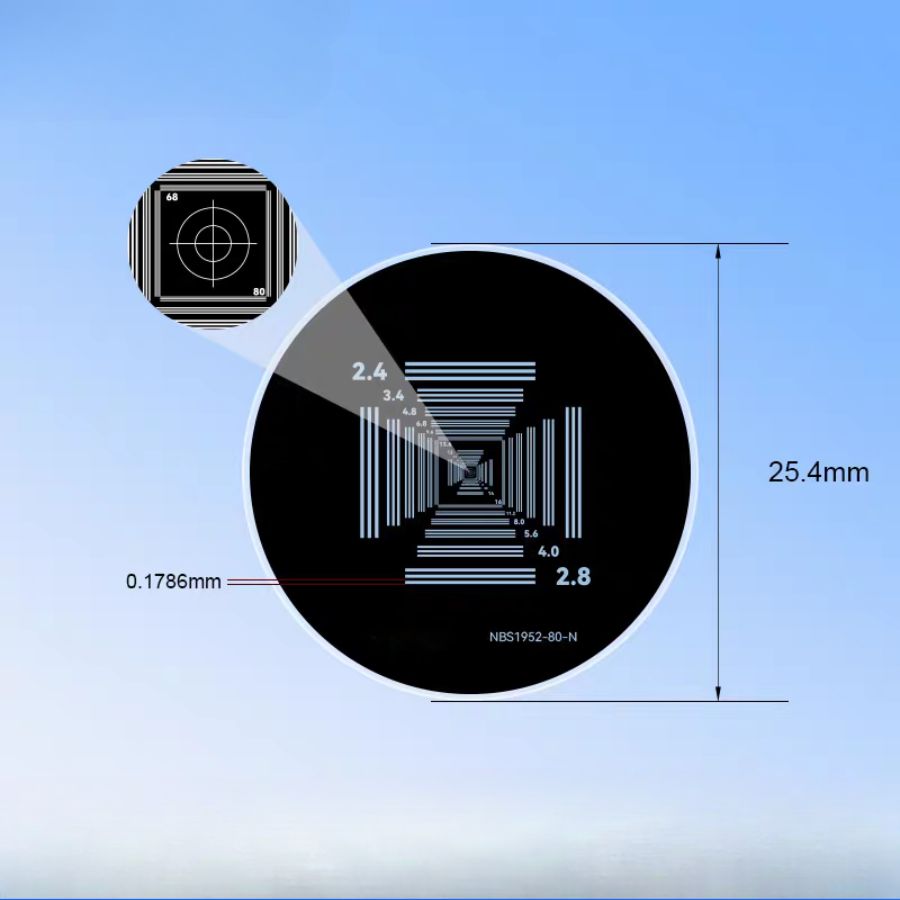
Ø25.4 mm
Opaque-field pattern in the same round format, with transparent bars for transmission viewing.
Long three-bar groups for focus adjustment and directional resolution readings.
Three-bar groups for microscope focus and horizontal/vertical resolution checks.
The finished component is a patterned glass target. Inspection covers bar widths and gaps, line count, orientation, edge quality and film defects within the active field. Dimensional or optical measurement records can be included in the agreed delivery scope.
The target is supplied with the selected NBS frequency map, field layout, polarity and glass format. The artwork revision identifies the pattern used for subsequent test records.
That distance belongs to a historical photographic-lens test arrangement with approximately 25:1 reduction. Modern glass targets can be used at other imaging scales. Calculate image-plane frequency from the physical target frequency and the measured magnification.
NBS 1952 resolution targets provide labelled or scaled multidirectional bars for repeatable imaging comparisons.
Choose the frequency artwork first, then the polarity and physical format. Record magnification and sampling for a meaningful reading.
Artwork reference, frequency range, polarity, plate format, illumination and magnification.
They can be configurations within the same pattern family. Select the frequency artwork before the polarity and outline.