Focus adjustment
Compare how far genuine, continuous spokes remain distinguishable towards the centre at different focus settings.

Siemens star resolution targets for lens focus, directional sharpness and imaging-system comparisons. Compare pattern density, usable frequency range and glass formats.
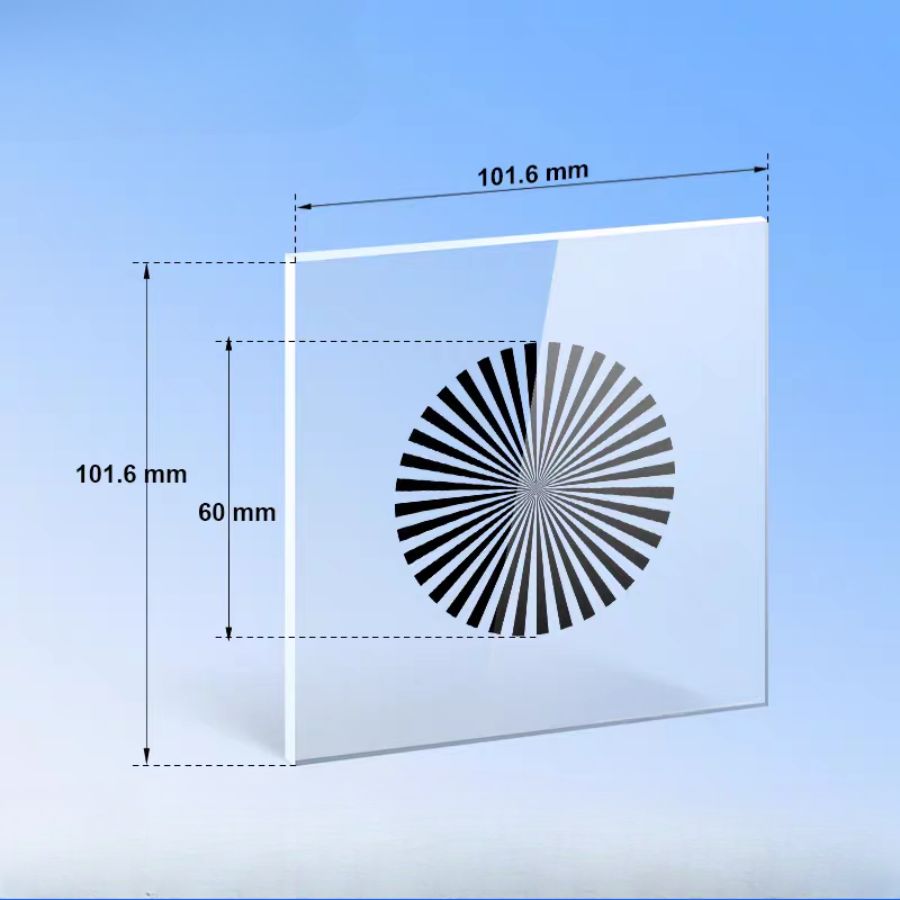
A Siemens star uses alternating clear and opaque radial sectors. Detail becomes finer towards the centre, so one pattern can show how focus and resolved detail vary with direction.
Choose it for focus adjustment, directional sharpness comparison and repeat checks of cameras, lenses or microscope optics. The usable pattern is the annulus between its defined inner and outer boundaries.
Compare how far genuine, continuous spokes remain distinguishable towards the centre at different focus settings.
Compare equal radii in different directions and repeat at image edges when field performance matters. False central spokes can arise from sampling or processing.
| Choice | Selection basis |
|---|---|
| Line-pair count | More pairs give finer detail at the same radius. Choose the count with magnification and sensor sampling. |
| Usable annulus | The active outer diameter and inner boundary define the available frequency range together with the pair count. |
| Illumination and holder | Match clear/opaque sectors to the light path and keep the holder clear of the active star. |
A binary chrome star and a sinusoidal star use different input waveforms. Visual spoke readings do not by themselves produce an MTF curve.
Calculate the frequency at a chosen radius101.6 mm format
Fewer line pairs at a given diameter offer a coarser frequency field. Match the actual count to the imaging scale.
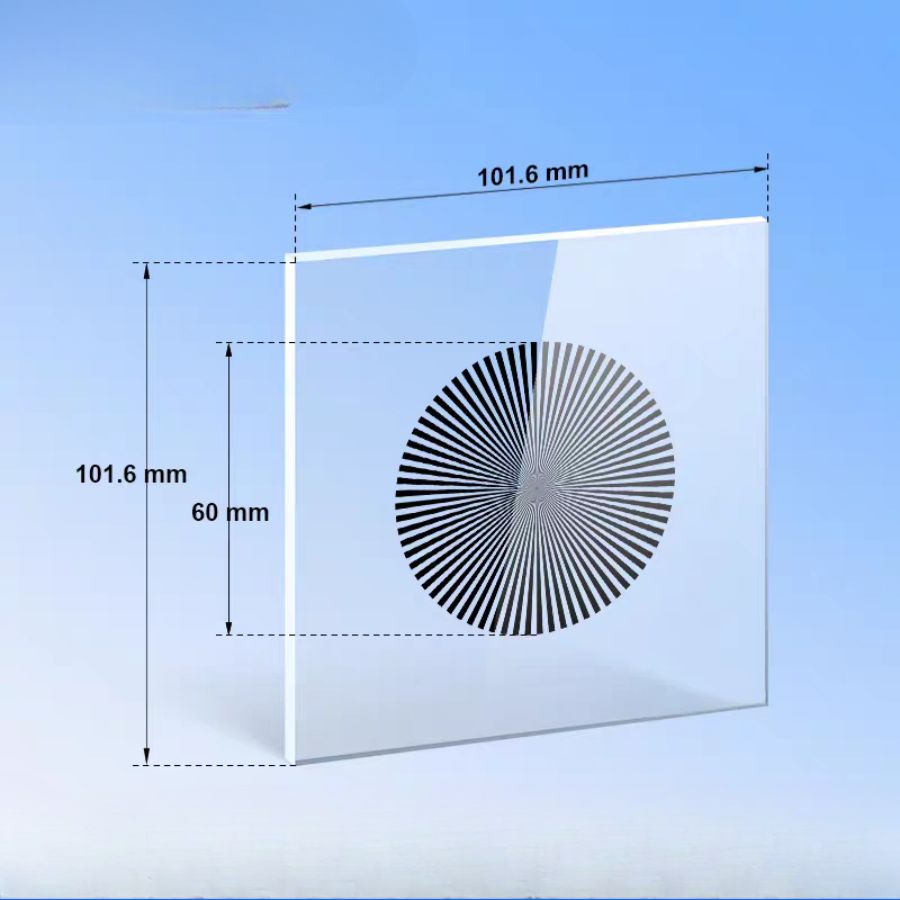
101.6 mm format
More line pairs increase frequency at each radius. Check that the finer regions remain usable with the sensor sampling.
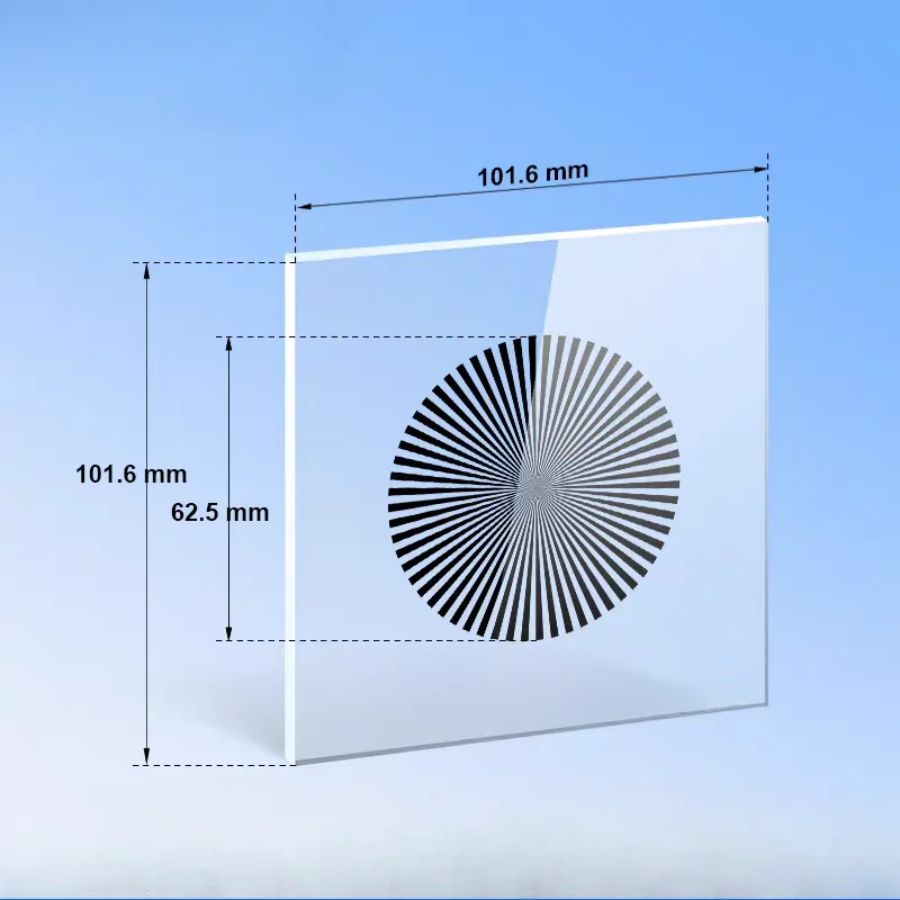
101.6 mm plate / 62.5 mm pattern
The 62.5 mm patterned field is distinct from the 101.6 mm glass format; the surrounding area provides mounting space.
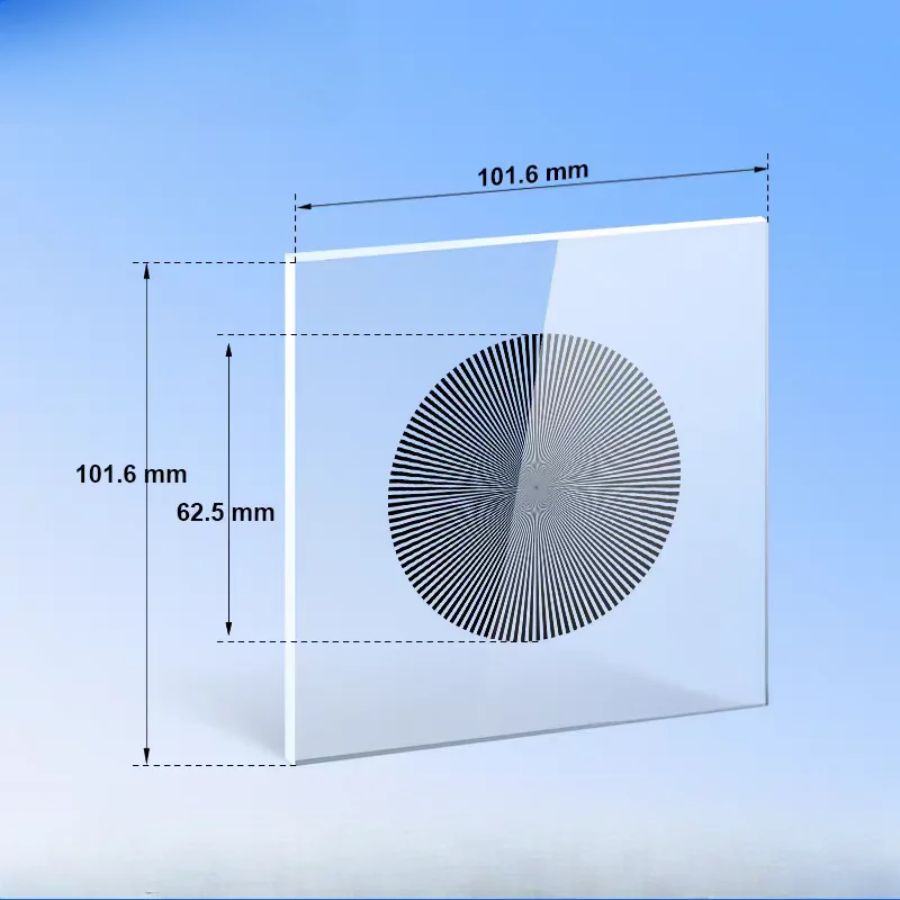
101.6 mm plate / 62.5 mm pattern
The same active field with greater pattern density; choose density and centre geometry as separate variables.

Dimensions to drawing
A square format for flat mounting and edge clamping. Keep the active star clear of the fixture.

Diameter to drawing
A circular format for a round holder. Specify mounting diameter separately from the active star diameter.
Radial sectors for comparing focus and direction in one field.
Radial detail for microscope focus and directional sharpness checks.
Inspect angular spacing, radial edge quality, centre placement and the usable inner boundary. Check film defects and optical contrast at the specified wavelength, with substrate geometry assessed for the mounting arrangement.
The selected star pattern is supplied on the specified glass format, with the active diameter, inner boundary and pair count defined separately from the mounting dimensions.
Siemens star targets use alternating sectors converging on a centre to show multiple orientations and detail scales in one image.
Observe from the coarser outer region towards the centre, comparing directions and checking aliasing. Quantitative evaluation requires the matching geometry and method.
Sector count, diameter, central geometry, polarity, substrate and imaging configuration.
Follow distinguishable stripes towards the centre and compare directions. Record magnification and the reading criterion for repeatable results.