Applications and compatible instruments
For visual resolving-power checks and comparison of imaging systems using an established bar-chart method.

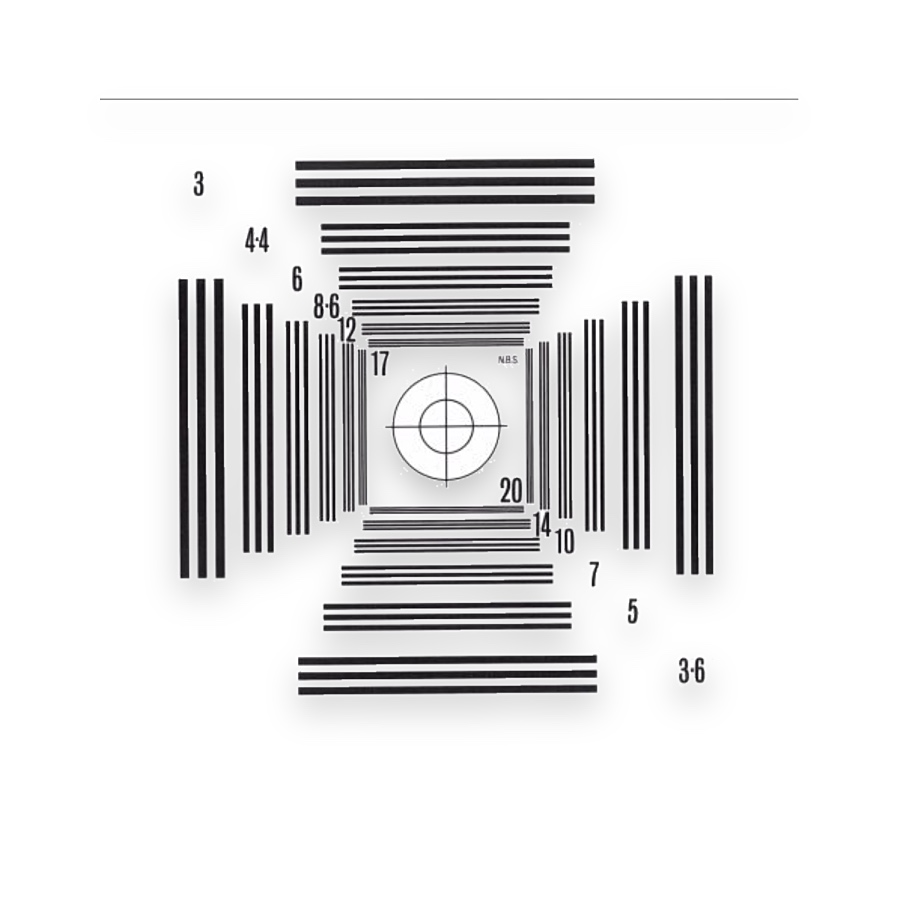
The R60 pattern belongs to the NBS 25 resolution-target family. It is distinct from the NBS 1963A five-bar pattern; use the frequency and orientation layout specified for the selected artwork.
Choose it for five-bar reading procedures and comparisons between horizontal, vertical and oblique detail. It is particularly useful when the same recognised pattern must be compared across repeated setups.
Checkerboards, dots and grids describe image geometry. Resolution charts describe detail reproduction. A calibration workflow may need both, but they answer different questions.
Pattern size, feature spacing, polarity, usable field, substrate outline and mounting references can be selected around the camera and illumination. Measured geometry and traceable calibration are separate documentation requirements.
A glass target in the selected pattern, polarity and substrate format, with the dimensional inspection or calibration records included in the order.
For visual resolving-power checks and comparison of imaging systems using an established bar-chart method.
Inspect bar count, width, spacing, orientations and frequency labels.
Quality & Inspection PhotolithographyCompare focus and resolved detail with this optical test pattern.
Specify the exact chart layout and frequency range. NBS layouts are not interchangeable with USAF group-and-element conventions.
The R60 pattern belongs to the NBS 25 resolution-target family. It is distinct from the NBS 1963A five-bar pattern; use the frequency and orientation layout specified for the selected artwork.
Match this artwork reference to its labelled dimensions, polarity and active field. The product image, manufacturing artwork and inspection drawing should identify the same revision.
Artwork reference, labelled geometry, active area, substrate outline, illumination and inspection requirements.
Use the pattern reference and its specific geometry, labels and intended measurement. A similar outline or photograph does not establish the same frequency, coordinates or reading convention.