Centring and symmetry
Nested square frames make offsets between the image centre and the pattern centre visible.

Nested-square glass targets for pixel-to-length calibration, centring, alignment and qualitative distortion checks. Define square sizes, gaps, line widths and measurement method.
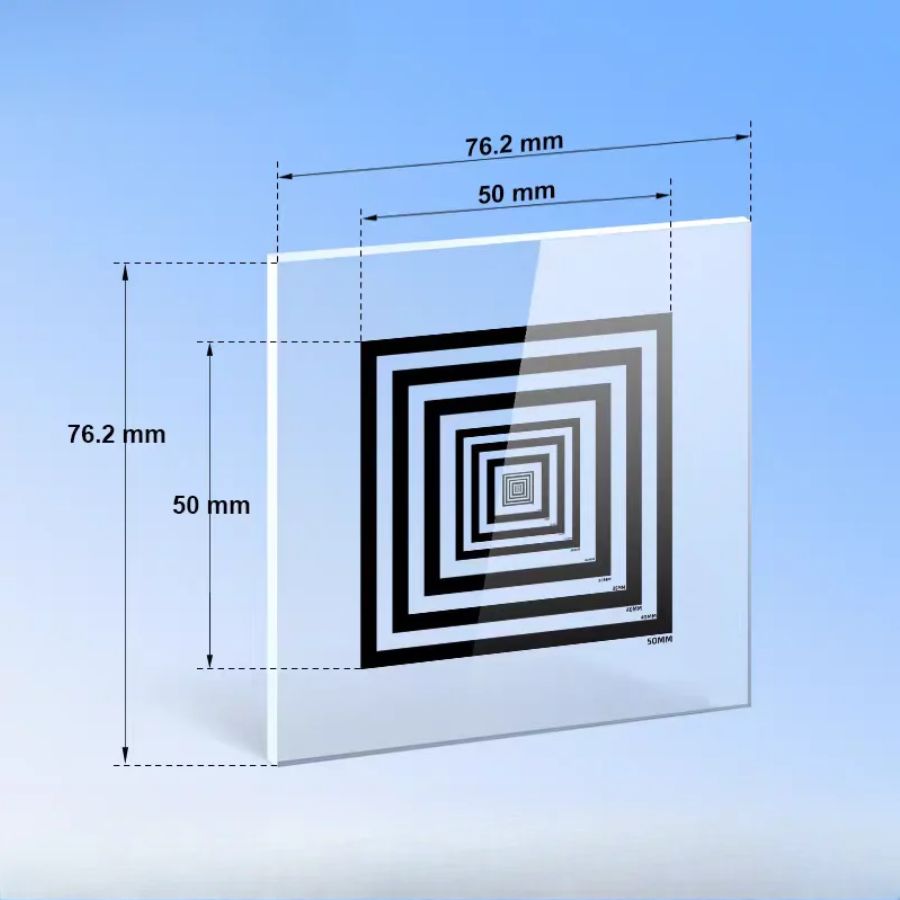
A concentric-square target places several straight-edged squares around a common centre. Their known spans provide a two-dimensional length reference, while the shared edges and corners help align an optical axis or inspect field geometry. The target is a scale and alignment reference; it does not automatically replace a camera calibration board or a resolution chart.
Choose this family when the result you need is a physical scale, a repeatable centre or a check of edge geometry. Use a checkerboard or dot array when software must solve a full intrinsic and distortion model, and use USAF, NBS or Siemens patterns when the question is optical resolution.
Nested square frames make offsets between the image centre and the pattern centre visible.
Known side lengths can support local pixel-scale checks; unequal sides or curved edges require perspective and distortion to be considered separately.
| Choice | Selection basis |
|---|---|
| Nested sizes | Select side lengths and frame spacing for the required field and image magnification. |
| Measurement boundary | Define whether coordinates refer to line centres, inner edges or outer edges. They give different dimensions for a finite-width line. |
| Reference orientation | Use the intended plane and orientation. A tilted board changes apparent geometry even without lens distortion. |
76.2 mm plate
Primary 76.2 mm family view with nested frames around a shared centre. Confirm each nominal span from the drawing.
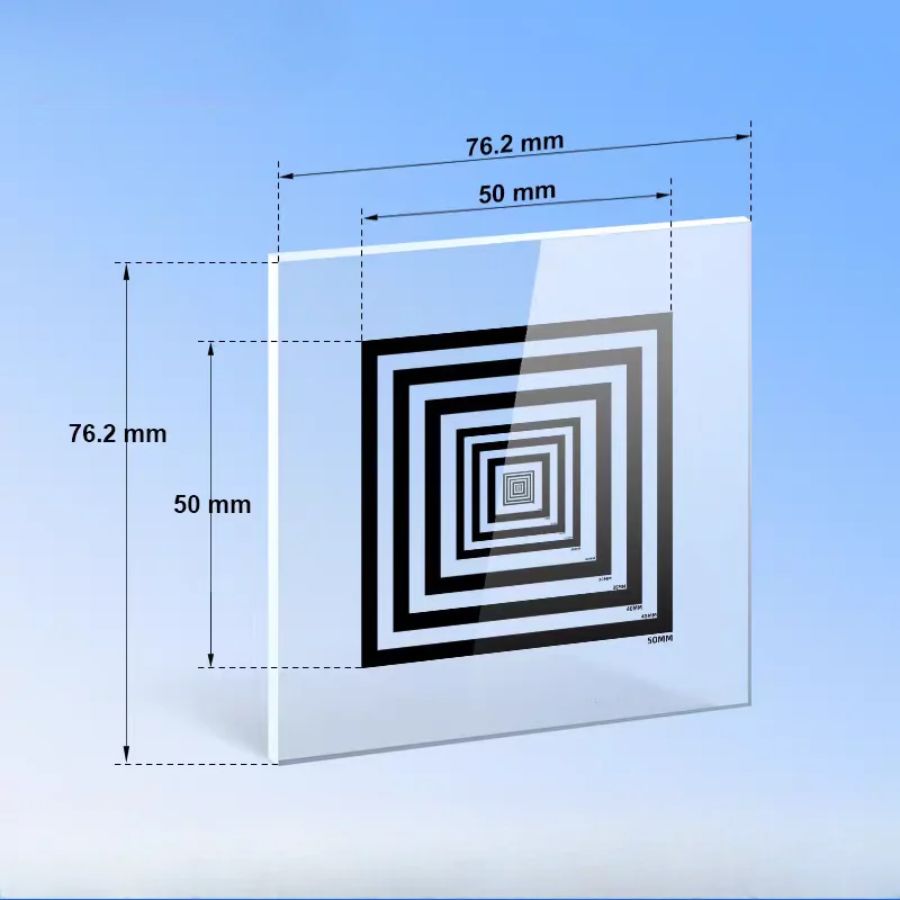
76.2 mm plate
Alternate view of the same concentric-square family; the image does not create a separate product type.
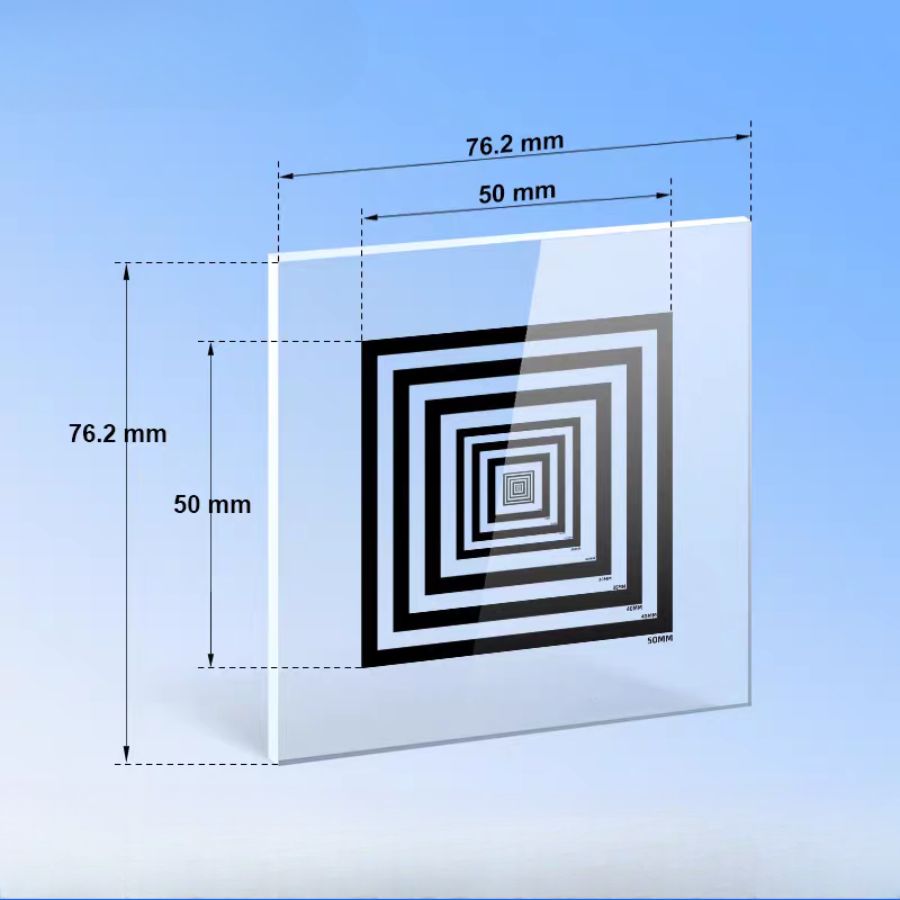
76.2 mm shown
Dimensioned view for configuration review. Use the drawing rather than the photograph as the controlling dimensional source.
Nested frames show image centring, edge straightness and apparent geometry across the camera field.
Known frame spans establish local image scale at the microscope specimen plane.
Inspect side lengths, frame spacing, straightness, corner geometry and concentricity over the active area. The report should state whether values are nominal or measured and whether dimensions refer to line centres, inner edges or outer edges.
The selected nested frames are supplied on glass with the stated edge convention, dimensions and reference centre.
No. A square has rotational symmetry. Add a datum mark or use the fixture orientation when a unique X/Y direction is required.
Concentric-square targets provide known nested outlines for scale, centre and geometric checks.
Specify frame dimensions, line width, shared centre and orientation. Distinguish perspective effects from lens distortion when reading the image.
Frame dimensions, centre, line width, active area, substrate and imaging geometry.
A square image can check specific geometry. Full intrinsic and distortion calibration needs the observations and model required by the calibration method.