Versus standard soda-lime glass
B270 eliminates the green iron tint of standard soda-lime glass and delivers superior transmission from UV-A to near-infrared (NIR).
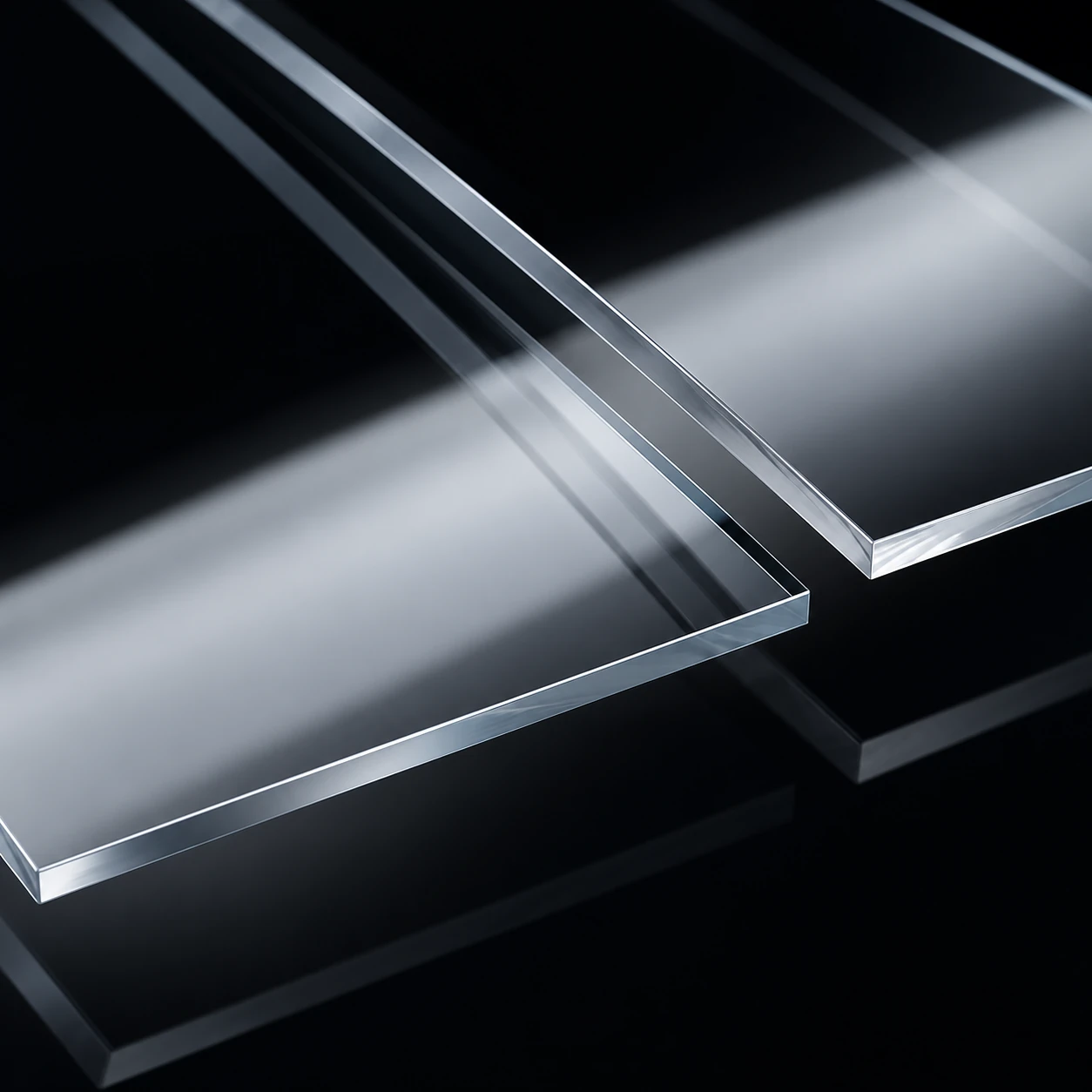
SCHOTT B270 is a high-purity, modified soda-lime glass formulated to prevent discoloration. It operates as a passive optical transmission window across the 320 nm to 2600 nm spectral range. Featuring a homogeneous refractive index (nd = 1.5230) and high solarization stability (UV edge shift < 2 nm after radiation), incident light transmits with negligible scattering. The material is supplied either as a terminal optical window or as a bare substrate for physical vapor deposition (PVD) metal and dielectric coatings.
Common aliases include B270 Superwite and Ultra-White Soda-Lime Glass. Compared with standard soda-lime glass, B270 eliminates the green iron tint and delivers superior transmission from UV-A to near-infrared (NIR). Compared with JGS fused quartz, it is a highly cost-effective substrate when the application does not require extreme high-temperature resistance or deep-UV (below 300 nm) transmission. SCHOTT and B270 are trademarks of their respective owners. TL OPTIK processes this glass as a substrate material and does not claim official distributorship, partnership, certification, or exclusivity.
Request a QuotePhysical optical constants below are catalog / datasheet values for SCHOTT B270. TL OPTIK manufacturing limits are the in-house laser-cut, concentricity and large-format lithography boundaries stated here. Finished thickness and surface quality are confirmed on the inquiry, approved drawing or quotation.
| Property | Specification |
|---|---|
| Material | SCHOTT B270 ultra-white crown glass (modified soda-lime) |
| Refractive index | nd = 1.5230, ne = 1.5251 (typical / catalog) |
| Abbe value | νe = 58.3 ± 0.6 (typical / catalog) |
| Luminous transmittance | > 91.9% (2.0 mm thickness, D65, uncoated) |
| Density | 2.56 g/cm³ |
| Coefficient of thermal expansion (CTE) | 9.4 × 10⁻⁶·K⁻¹ (20 °C to 300 °C, static measurement) |
| Laser-cut dimensional tolerance | ±0.02 mm to ±0.05 mm (TL OPTIK in-house cutting limit) |
| Concentricity | ≤ 20 µm (TL OPTIK in-house machining limit; 5 µm is not accepted) |
| Lithography | Finest 8 µm; recommended >10 µm (large-format plate replication limit) |
A qualitative comparison of SCHOTT B270, JGS silica grades and standard soda-lime (green) glass. Use it to choose a starting material, then confirm transmission, thickness and process limits on the inquiry. Compare also the dedicated pages for JGS-3 IR-Grade Fused Quartz Substrates and Soda-Lime Glass Substrates.
| Substrate | UV selection | Infrared selection | Cost considerations | Typical use |
|---|---|---|---|---|
| SCHOTT B270 | Not a deep-UV substitute | Check transmission at wavelength and thickness | Confirm dimensions and finish | Instrument windows, encoder discs, calibration-target substrates |
| JGS-1 / JGS-2 / JGS-3 | JGS-1: deep-UV candidate; JGS-2: verify wavelength; JGS-3: not a deep-UV substitute | JGS-3 reduces OH absorption; verify grade and thickness | Depends on grade and finish | Wavelength-specific optical substrates; qualify laser and thermal requirements separately |
| Standard soda-lime (green glass) | Verify UV cutoff and thickness | Verify composition and absorption | Often economical; finish affects cost | Protective plates and patterned substrates where optical requirements permit |
B270 eliminates the green iron tint of standard soda-lime glass and delivers superior transmission from UV-A to near-infrared (NIR).
B270 is a cost-effective substrate when the application does not require extreme high-temperature resistance or deep-UV transmission below 300 nm.
The material is supplied as a finished optical window or as a bare substrate for PVD metal and dielectric coatings. Thickness and Scratch-Dig are confirmed on the inquiry, drawing or quotation.
TL OPTIK processes B270 substrates utilizing in-house laser cutting (precision limit: 0.02 - 0.05 mm) and CNC machining. For circular geometries, maximum concentricity is controlled at 20 µm. Double-sided optical polishing, when required for tightened flatness or Scratch-Dig specs, is executed as an independent manufacturing process batch.
For custom reticles or encoder discs printed on B270, customers must submit DXF or GDSII format drawings, explicitly defining pattern polarity and datum references. Technical drawing processing commences strictly after the master plate fee is secured. See also Optical Encoder Discs and Calibration Targets.
Finished thickness and surface quality / Scratch-Dig are confirmed on the inquiry, approved drawing or quotation. This page does not publish a stock-thickness range or a standard bare-delivery Scratch-Dig grade.
Dimensional inspection follows the approved drawing and the quoted laser-cut or CNC tolerance. Circular parts are checked against the agreed concentricity, which cannot be tighter than the 20 µm in-house limit. When a pattern is specified, line width and spacing are inspected to the drawing; the large-format replication limit is 8 µm, and features above 10 µm are recommended for yield and stability. Finished thickness and surface quality / Scratch-Dig are inspected only to the values agreed on the inquiry, drawing or quotation.
Our in-house laser cutting achieves a structural tolerance of 0.02 mm to 0.05 mm.
No. Our physical manufacturing boundary for concentricity is 20 µm.
The absolute finest line width and spacing we reproduce is 8 µm, but we strongly recommend feature sizes above 10 µm for optimal yield and stability.