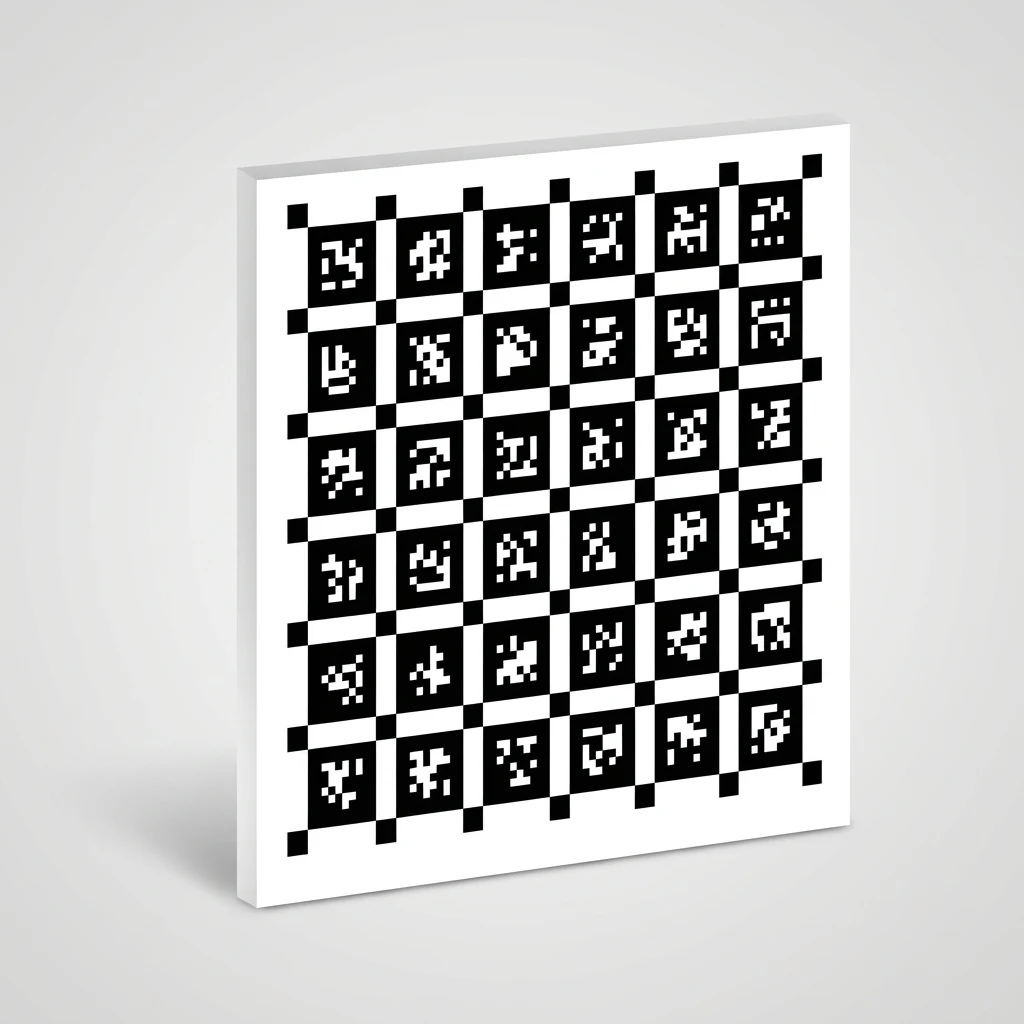
Photolithographic AprilGrid targets with uniquely coded AprilTag markers for monocular, stereo and multi-camera calibration, and for camera-to-IMU extrinsic calibration with toolkits such as Kalibr.
An AprilGrid is a calibration board of AprilTag markers arranged on a known grid for monocular, stereo, multi-camera and camera-to-IMU calibration.
TL OPTIK manufactures the patterned optical component. Use with Kalibr or another workflow depends on the agreed tag family, grid geometry and software settings, not on a generic certification.
Coded AprilTag markers on a known grid
An AprilGrid is a calibration board of AprilTag markers arranged on a known grid. Each tag carries its own ID and orientation, so compatible software can keep using the tags that remain visible when the plate is partly clipped, blocked or close to the edge of the field of view.
TL OPTIK manufactures the patterned optical component by photolithography. Use with Kalibr or another camera, stereo or visual-inertial workflow depends on the agreed tag family, grid geometry and software settings, not on a generic certification. Specify the tag family, tag size, spacing, array, polarity, coating and substrate on the drawing.
These targets are patterned by photolithography. Compare a layout using the agreed tag family, grid geometry, coating contrast and substrate under the intended imaging conditions; the pattern name alone does not establish calibration accuracy.
AprilGrid, AprilTag and Kalibr are trademarks of their respective owners.
Why specify a photolithographic AprilGrid target
AprilGrid boards are used in computer vision, robotics and visual-inertial calibration, including monocular and stereo cameras and camera-to-IMU extrinsics. The points below describe the coded layout. They are not system-level performance guarantees.
Partial-view and occlusion tolerance
Because each tag has its own black-and-white binary code, compatible software can keep detecting the tags that remain in the image when an edge is held, clipped or close to the field border. This describes how the coded layout is used, not a guarantee that every pose, lighting condition or software version will succeed.
Unique ID and orientation
A plain black-and-white chessboard can be ambiguous under some viewpoints or after a 180° flip. Each AprilTag has a defined orientation and ID, which helps compatible detectors avoid that symmetry. It does not replace a correct board definition in the calibration software.
High-contrast corners for sub-pixel measurement
The high-contrast chrome edges give compatible image-processing algorithms a clear boundary for sub-pixel corner extraction. The resulting camera or IMU calibration accuracy still depends on the camera, lens, lighting, pose set and software.
Multi-camera and camera-IMU work
AprilGrid boards are commonly used with toolkits such as Kalibr for monocular, stereo and camera-to-IMU calibration, including time and spatial extrinsics in visual-inertial work. TL OPTIK supplies the patterned plate, not a complete VIO, SLAM or navigation system.
Technical specifications and custom options
The tables below transcribe the supplied glass and ceramic data, with units and measurement conditions retained. They are material and process options, not one combined guarantee for every board. Coating-thickness tolerance on the 120 nm glass chrome layer, and the 500 × 500 × 4.8 mm glass format, are confirmed on the quotation.
Glass-substrate AprilGrid
Pattern, coating and substrate values are listed separately so a reflective coating specification is not read as a glass transmittance guarantee.
Glass-substrate AprilGrid pattern and coating
Parameter
Pattern and coating
Patterning method
Photolithography
Minimum linewidth
1 μm / 0.55 μm, as reviewed with the artwork
Feature and overall accuracy
±1 μm
Coating
Yellow chrome, low-reflective blue chrome, or bright chrome
Reflectance
< 13.4% at 550 nm; < 1.8% at 650 nm; < 2.67% at 750 nm, as listed for the supplied coating data
Coating thickness
120 nm; thickness tolerance is confirmed on the quotation
Optical density (OD)
OD 3 for yellow chrome; OD 5 for blue chrome
White backing
Minimum linewidth 10 μm; 40 μm smooth white coating on the reverse
A thin film over the chrome to improve pattern durability
A thin film over the chrome to improve pattern durability
Ceramic-substrate material data
Parameter
Ceramic substrate
Type
Matte chrome on matte ceramic, or bright chrome on glossy ceramic
Ceramic substrate
Zirconia or alumina
Thickness
1 mm (±0.1 mm, common), 2 mm (common), or 3 mm (±0.1 mm)
Surface flatness
< 30 μm for length < 100 mm; < 60 μm for length < 200 mm
Minimum / maximum size
From 2 × 2 mm (±0.1 mm) up to 228 × 228 mm (±0.1 mm)
Surface roughness
< 0.2–0.7 μm
Coefficient of thermal expansion
< 6.7 × 10⁻⁶/K at 40–400 °C
Density
≥ 3.66 g/cm³
Hardness
≥ 80 HRA
Outline
Square, ellipse, or a laser-cut custom outline
Special features
Holes, chamfers or bevels as agreed on the drawing
Selecting a substrate and coating
Substrate, coating and polarity should follow the lighting, mechanical envelope and software workflow. Film and aluminium can be quoted, but they do not use the glass or ceramic values below.
1Glass substrates
Fused silica or soda-lime glass is listed for transmissive or mixed illumination, with transmittance quoted at 550 nm as given in the supplied data. Choose yellow chrome, low-reflective blue chrome or bright chrome to match the lighting. Maximum size in the supplied data is 800 × 960 mm.
2Ceramic substrates
Alumina or zirconia ceramic is listed for front-lit work where a stiffer plate is useful. Matte chrome is paired with matte ceramic, and bright chrome with glossy ceramic. Maximum size in the supplied data is 228 × 228 mm. These ceramic plates are reflective components; do not treat the glass transmittance figures as ceramic values.
3Other materials on request
Film and aluminium plates can be reviewed for a stated environment or accuracy requirement. No thickness, flatness or linewidth values are listed for those materials on this page; they are confirmed on the drawing and quotation.
Inspection and what to send
Glass cutting, double-sided polishing, coating, resist coating, exposure, develop and etch, and inspection are carried out in house. That confirms process ownership; it does not by itself confirm a particular instrument, tolerance or certificate for every plate.
A target measurement record is separate from the accuracy of an installed camera or IMU system.
Tag family or dictionary, for example the AprilTag family required by your software.
Array size (rows × columns), tag size, spacing or grid period, and overall outline.
Polarity (positive or negative), coating and any white backing or protective layer.
Substrate material and thickness: fused silica, soda-lime glass, zirconia or alumina ceramic, or another material to be quoted.
The approved drawing, CAD or artwork, including holes, chamfers, bevels or a non-square outline.
Intended cameras, lighting (front-lit or back-lit) and software, such as Kalibr, so the geometry can be reviewed against that workflow.
Common questions
How is an AprilGrid different from a chessboard or a ChArUco board?
A conventional chessboard provides inner corners but no coded IDs. A ChArUco board places ArUco markers in the white squares of a chessboard. An AprilGrid is an array of AprilTag markers on a known grid. They are different products and are not interchangeable unless the detector, dictionary and board definition all match the finished plate.
Is the board certified for Kalibr or a specific VIO system?
No. Boards can be manufactured to a stated AprilGrid geometry for use with Kalibr or another visual-inertial workflow. That is pattern and workflow matching, not a software certification, and not a claim that the plate works with every version or every sensor rig. TL OPTIK supplies the patterned component, not a complete IMU, robot or navigation system.
Can the board still be used when some tags are hidden?
Compatible software can keep using the tags that remain visible, because each tag has its own ID and orientation. The result still depends on how many tags stay in view, the camera, lens, lighting and the detector settings. It is not a promise that any amount of occlusion will succeed.
Which material should I choose?
Glass is listed where transmittance or a larger format is needed; ceramic is listed for front-lit, stiffer plates up to 228 × 228 mm in the supplied data. Film and aluminium are available on request and are quoted separately. Match the coating to the lighting: low-reflective blue chrome, yellow chrome or bright chrome on glass, and matte or bright chrome on the corresponding ceramic finish.
What values are still confirmed on the quotation?
Coating-thickness tolerance on the 120 nm glass chrome layer, and the 500 × 500 × 4.8 mm glass format listed in the supplied data, are confirmed on the quotation rather than treated as standing guarantees. Other listed values keep the units and measurement conditions given in the source data, and should still be tied to the selected substrate, coating and artwork.
Related calibration targets
Compare this coded AprilTag grid with ChArUco boards, OpenCV chessboards and Data Matrix calibration targets.