Film-side anti-reflection (Glass / Cr / CrOₓ)
The CrOₓ top layer faces the wafer or resist-coated workpiece during contact and proximity exposure, absorbing light reflected back from the wafer surface.
Custom anti-reflective chrome-coated blanks on soda-lime glass, borosilicate or fused silica. Specify film stack (Cr/CrOₓ or CrOₓ/Cr/CrOₓ), optical density, surface reflectivity and optional photoresist coating.
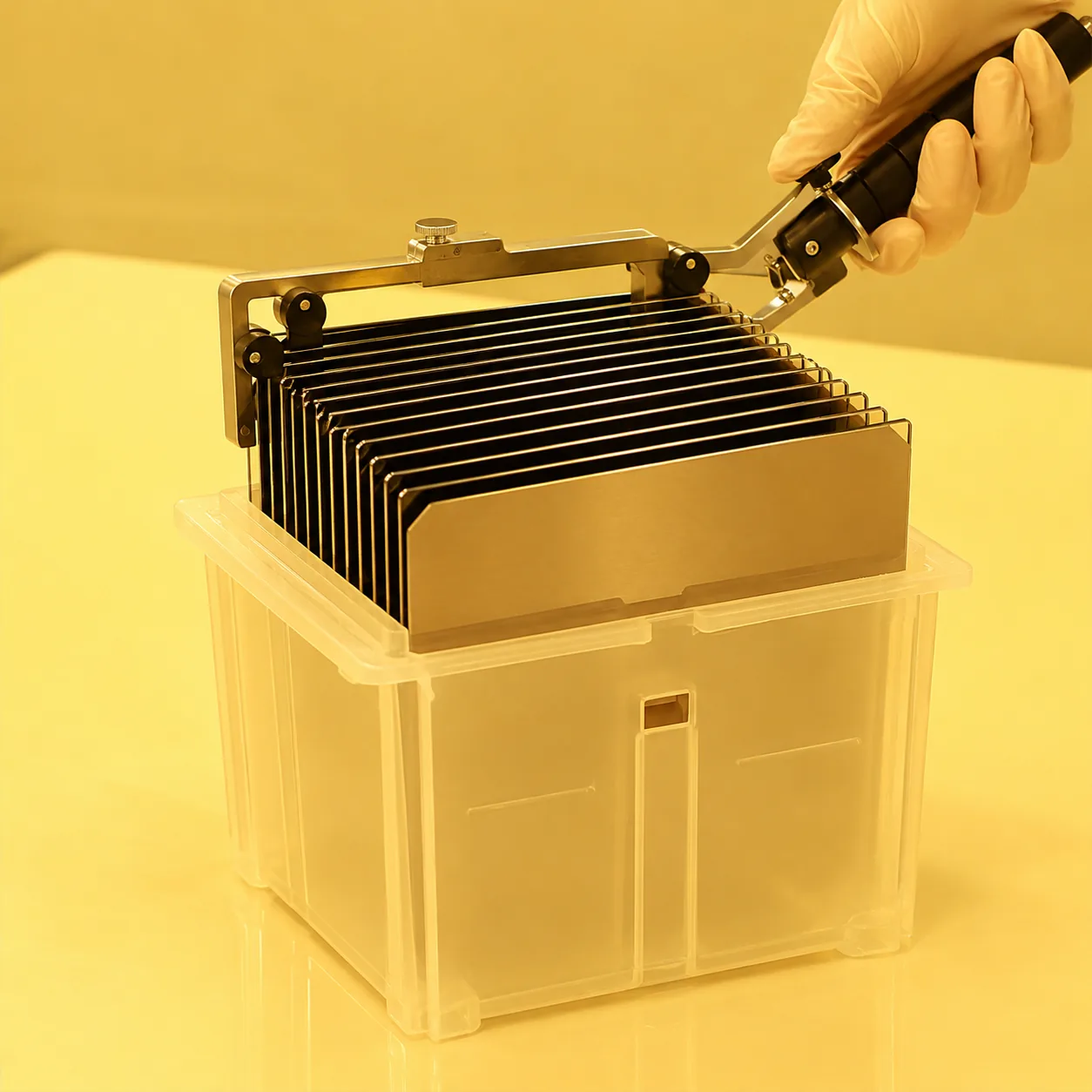
Low-reflective black chrome photomask blanks are unpatterned glass or fused silica plates with a CrOₓ/Cr or CrOₓ/Cr/CrOₓ anti-reflective chrome stack. They are the low-reflection counterpart to bright metallic chrome blanks, used for lithography exposure, laser writing and high-contrast optical components.
Blanks are supplied either as uncoated black-chrome plates or pre-coated with positive/negative photoresist.
Select the anti-reflective layer position and resist condition around your writing and exposure geometry.
The CrOₓ top layer faces the wafer or resist-coated workpiece during contact and proximity exposure, absorbing light reflected back from the wafer surface.
Suppresses reflections on both the glass-incident side and the air/film side. Chosen for double-sided optical alignment, dark-background machine vision targets, and transmission encoder discs where stray glare from the housing must be minimized.
Order bare CrOₓ/Cr/CrOₓ blanks when your facility runs its own spin/slit resist coating or laser ablation, or specify a photoresist-coated blank ready for direct UV laser writing or mask aligner exposure.
Film thickness, optical density and surface reflectivity are agreed at the specified wavelength and confirmed on the drawing or quotation. Standard square formats are listed below; other sizes follow the drawing.
| Property | Specification |
|---|---|
| PropertyProduct type | SpecificationUnpatterned low-reflective black chrome photomask blank (bare film or photoresist-coated) |
| PropertyFilm stack architecture | SpecificationPVD sputtered Cr/CrOₓ (2-layer, film-side AR) or CrOₓ/Cr/CrOₓ (3-layer, dual-side AR) |
| PropertyTotal film thickness | SpecificationSpecified to the target optical density and confirmed on the drawing or quotation. |
| PropertyOptical density (OD) | SpecificationSpecified at the working wavelength and confirmed on the quotation. Values such as OD ≥ 3.0, 4.0 or 5.0 may be given as inquiry inputs; they are not a guaranteed stock floor. |
| PropertySurface reflectivity | SpecificationLow surface reflectivity on the AR-treated side at the specified UV (365/405/436 nm) or visible (550 nm) band; the numeric limit is confirmed on the quotation. |
| PropertySubstrate materials | SpecificationSoda-lime glass, borosilicate glass (Borofloat 33), or UV fused silica (JGS-1 / JGS-2) |
| PropertyStandard and custom dimensions | SpecificationStandard square formats (2.5" × 2.5", 3" × 3", 4" × 4", 5" × 5", 6" × 6", 7" × 7") and other sizes according to the drawing. |
| PropertySubstrate thickness | SpecificationStandard 0.060" (1.52 mm), 0.090" (2.28 mm), 0.120" (3.0 mm), 0.250" (6.35 mm), or custom 0.3–10 mm per drawing |
| PropertySubstrate flatness | Specification2 μm to 10 μm TIR across quality area (or interferometric λ/4 on precision polished silica/glass) |
| PropertyPhotoresist coating (optional) | SpecificationSupplied uncoated (bare CrOₓ/Cr/CrOₓ), or pre-coated with photoresist when the resist brand/series and target thickness are specified on the inquiry. |
| PropertySurface quality and pinholes | SpecificationScratch-Dig 60-40 or 40-20; pinhole density controlled to lithography blank grade |
| PropertyEtching compatibility | SpecificationStandard ceric ammonium nitrate wet chemical etching, plasma dry etching (RIE), or direct laser ablation |
Compare how bright metallic chromium and oxidized black-chrome stacks behave inside lithography and optical reading systems.
| Criterion | Bright metallic chrome (Cr) | Low-reflective black chrome (CrOₓ/Cr/CrOₓ) |
|---|---|---|
| Film composition | Single-layer sputtered metallic Cr | Metallic Cr core sandwiched by graded CrOₓ anti-reflective layers |
| Typical surface reflectivity | High (~50%–65% at exposure/visible wavelengths) | Low surface reflectivity on the AR-treated side at the specified wavelength; the numeric limit is confirmed on the quotation. |
| Visual appearance | Mirror-like metallic silver reflection | Matte dark-brown, charcoal, or deep navy-black interference tone |
| Lithography linewidth control | Prone to multiple reflections between mask and wafer in fine-pitch contact/proximity printing | Suppresses back-scattered light, stabilizing critical dimension (CD) control on reflective substrates |
| Optical instrument contrast | High surface glare under coaxial or ring illumination | High visual contrast with minimal stray reflection for coaxial cameras and optical readheads |
| Wet / dry etching compatibility | Standard ceric ammonium nitrate wet etch or chlorine plasma dry etch | Compatible with standard chrome wet etchants and plasma processes (etch rate slightly faster in the CrOₓ cap) |
Start from an unpatterned black-chrome blank, or let TL OPTIK deliver the etched component to your CAD drawing.
Material, dimensions, surface, pattern, coating and documentation can be reviewed together when the standard configuration is not enough.
Soda-lime, borosilicate (for example Borofloat 33), or fused silica (JGS-1 / JGS-2), with outer dimensions, thickness and tolerances taken from the drawing.
Film-side only (Cr/CrOₓ) or both film side and glass side (CrOₓ/Cr/CrOₓ); optical density and the maximum allowable reflectivity at the working wavelength are confirmed on the quotation.
Bare black-chrome blank, or pre-coated with positive or negative photoresist, together with flatness, scratch-dig, pinhole limits and order quantity.
Review the system context, selection factors and information needed to define this component.
Short answers to the questions that affect material choice, pattern definition and acceptance.
The anti-reflective effect of CrOₓ/Cr/CrOₓ relies on destructive thin-film interference combined with optical absorption. Because the CrOₓ layer thickness is tuned to minimize reflection at specific UV or visible wavelengths (such as 365–436 nm or 550 nm), the surface exhibits a characteristic dark bronze, charcoal, or deep blueish-purple interference hue under ambient room light.
Yes. Both the metallic Cr core and the CrOₓ anti-reflective layers dissolve in standard ceric ammonium nitrate ((NH₄)₂Ce(NO₃)₆) + perchloric/nitric acid wet etchants, as well as chlorine/oxygen-based RIE dry plasma chemistries. Note that the oxidized CrOₓ cap layer typically etches slightly faster than pure metallic Cr, so exposure and development times should be calibrated to prevent excessive undercut.
Specify the side that faces the reflective light source or workpiece. In contact/proximity mask aligners, the film side (CrOₓ top cap) faces the wafer, so film-side anti-reflection is critical. If the blank will be used for a vision target, reticle, or double-side aligned mask viewed through the substrate, specify a three-layer CrOₓ/Cr/CrOₓ stack to suppress reflection on the glass-to-chrome interface as well.
Both supply states are available. Please state in your inquiry whether you require bare CrOₓ/Cr/CrOₓ blanks (uncoated with resist) or photoresist-coated black chrome plates, and specify the resist brand/series and target thickness if a coated plate is required. Positive resists such as AZ / S1800 series equivalents may be named as inquiry examples rather than as a guaranteed stock list.
Confirm these items after the product type and core parameters are selected. They define how the finished component is manufactured, checked and documented.
Before production, we confirm the substrate material grade, outer geometry, film stack configuration (Cr/CrOₓ vs. CrOₓ/Cr/CrOₓ), optical density (OD) and target reflectivity band. Spectrophotometer reflection and transmission curves specify whether measurements are taken from the air/film side or through the glass substrate. Pinholes, particle counts and surface flatness are inspected under cleanroom lighting and packaged in dust-free containers.
Send the drawing, reference artwork or preliminary specification for manufacturing and inspection review.
Discuss this product